On a mugwort label, the big number is leaf water
Mugwort appears on 54 Korean labels and five print an amount. Four share one shape, with the leaf water and the extract more than three thousandfold apart.
Mugwort is currently sharing the soothing ingredient slot with centella. You have probably seen a front label saying it is several times stronger than cica.
We read 54 Korean labels carrying something from the mugwort family. Five of them print an amount.
What makes those five interesting is not only that they print a number. It is that four of them have exactly the same shape.
The structure that repeats on the labels that print amounts
Mugwort appears on a label in one of three forms.
- Artemisia leaf water is water the leaves were steeped in. It fills the water phase.
- Artemisia leaf extract is a concentrated extract.
- Artemisia leaf powder is dried, ground leaf, and it goes into rinse off products.
Four of the five that print amounts are leave on products carrying both of the first two, and across those four the numbers come out like this.
- The leaf water runs from 10,554ppm to 35,724ppm, roughly 1 percent to 3.6 percent.
- The extract on those same labels is 10ppm.
Same plant, same label, more than three thousandfold apart. The big number you see on the front is almost always the leaf water.
That is not a trick. Steeping leaves and using that water in place of plain water is a real formulation choice, and printing the figure at all is rarer than not printing it. It only means you cannot read the big number as though it were the concentrated material. The same trap has the same shape on heartleaf.
A rare case where the name and the list agree
Five products carry mugwort in the name, and all five genuinely carry a mugwort ingredient.
That deserves credit. Putting an ingredient in the product name while it sits as a trace near the end of the list is common. On the mugwort side, that mismatch is currently absent.
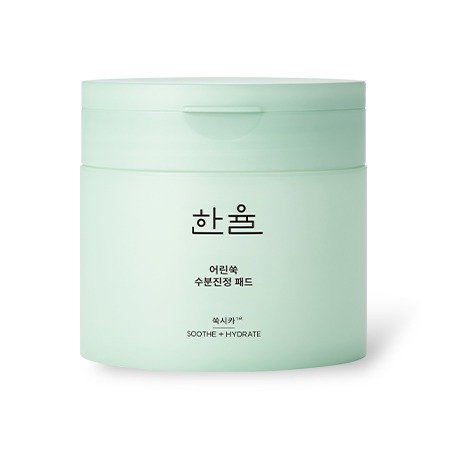
One brand even closes the naming gap itself. Pure Artemisia Calming Pad states on its page that the Ganghwa medicinal mugwort in its marketing is printed as 황해쑥, Artemisia argyi, on the ingredient list. That line is usually missing in this format.
The four times stronger than cica claim
This line is the face of mugwort skincare right now, so it is worth reading exactly.
Pure Artemisia Calming Water Cream and the pad in the same line both use it. And the brand prints the conditions in a footnote: against the company's own centella extract, by in vitro test.
Printing that footnote deserves credit. A bare four times with no conditions would be a sentence nobody could check. With the conditions there, it becomes readable.
Read it and it comes to this.
- It is an in vitro test. That result came from a dish rather than from a face.
- The comparator is the company's own centella extract rather than a market standard. It says which of two materials the company holds performed better in that assay.
- Neither side's concentration is stated. Without concentrations a multiple has no size.
For context, centella appears on 205 labels, roughly four times the mugwort count, and more of those centella labels print an amount. How to count centella is in how much cica is in a cica cream.
Eupatilin is not on the ingredient list
Mugwort product pages often name a molecule called eupatilin. It is genuinely mugwort derived and it genuinely has soothing literature behind it.
It is not printed as its own line item. What gets printed is leaf water and leaf extract.
The molecule is in the plant extract, certainly. How much of it is in there is not something a label lets you check. When the molecule being named and the entry being printed are different things, the printed one is the checkable one.
Mugwort belongs to the Asteraceae family
This has to travel with any plant sold as a calming ingredient.
Mugwort is an Asteraceae plant, and Asteraceae is a long studied family in contact allergy. The main allergens in it are a group of compounds called sesquiterpene lactones.
This is not an industry position, it is diagnostic standard practice. A sesquiterpene lactone mix sits in the European baseline patch test series, and positive reaction rates run around 1 percent on average in Europe and about 0.8 percent in North America. Outside those regions the reported range is wider, from 0 percent to 10.7 percent.
So it comes down to this.
- For most people it is not an issue. That is what a figure around 1 percent means.
- If you have ever reacted to ragweed, chrysanthemum or chamomile, mugwort is in the same family. Here the soothing category on the front is not a reason for reassurance.
- And the risk exists regardless of whether the label says leaf water or extract.
Patch testing is particularly reasonable with this family.
How far does the evidence go?
At the cell level there is something. Mugwort extract raised filaggrin and loricrin expression in human keratinocytes, both barrier proteins, through an identified pathway.
But the species has to match. That study used Artemisia princeps, and the paper introduces the plant by its Japanese name, yomogi. The four labels that disclosed an amount above print Artemisia argyi, which Korean lists write as 황해쑥. In Korean ingredient naming those are two different entries.
So that cell result does not carry straight over to an Artemisia argyi product. The label here that matches the study's species is actually the Isntree one, whose entry is Artemisia princeps leaf powder. Findings not transferring across a family is the standing problem whenever an ingredient name points at a group rather than a molecule.
Above that level it is thin. We found no trial isolating a mugwort ingredient on human faces. Product level tests exist, but those look at finished products rather than at mugwort.
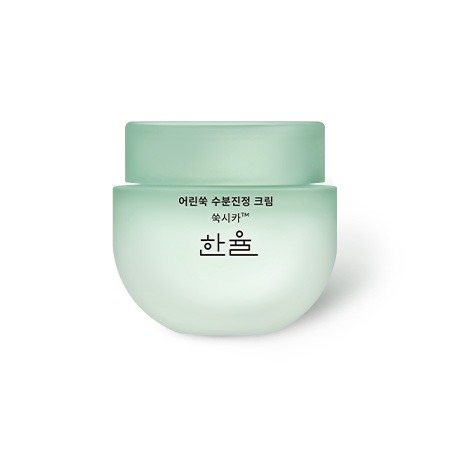
Product level tests need reading too. The Hanyul cream page names its testing institution, a 30 person panel and the testing dates, which more pages should do. But two of its figures carry conditions. The dryness improvement was scored by participants rating themselves, and the three times longer hydration was measured against the brand's own previous version of the same cream.
A figure with its conditions printed beats a figure without them. And once you read the conditions, the size of the figure changes. Both of those are true at once.
Reading the four labels
Pure Artemisia Calming Water Cream puts Artemisia leaf water fifth at 35,724ppm, the largest of the four. Across 39 ingredients there is no plant oil, no butter and no drying alcohol. Niacinamide sits seventh.
Pure Artemisia Calming Pad prints both numbers, leaf water at 18,944ppm and leaf extract at 10ppm. It is this article's structure visible inside one label. There is no exfoliating acid, no drying alcohol and no essential oil, with allantoin, dipotassium glycyrrhizate, beta glucan and centella behind the mugwort.
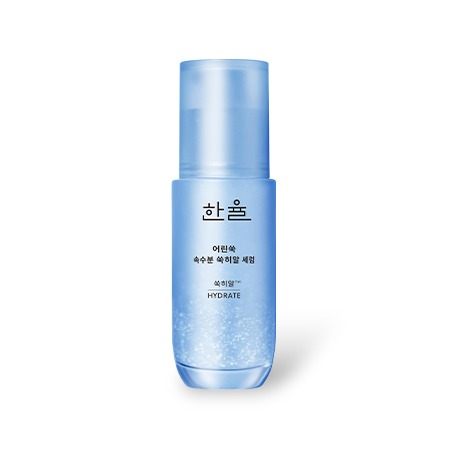
Artemisia Hydrating Serum gives hyaluronic acid equal billing in its name, and the label does not. Artemisia leaf water is at 10,554ppm, hyaluronic acid at 100ppm and sodium hyaluronate at 1.5ppm. Ceramide NP and phytosterols are on the list as well.
The 34 percent figure on this page comes with conditions the brand printed itself: an in vitro comparison against hyaluronic acid as a raw material. That is material against material rather than this serum measured on skin.
If you are avoiding fragrance, all three Hanyul products above are out. It is a soothing line that carries fragrance, with no allergen breakdown printed. How to separate fragrance from essential oils is in fragrance free versus essential oils.
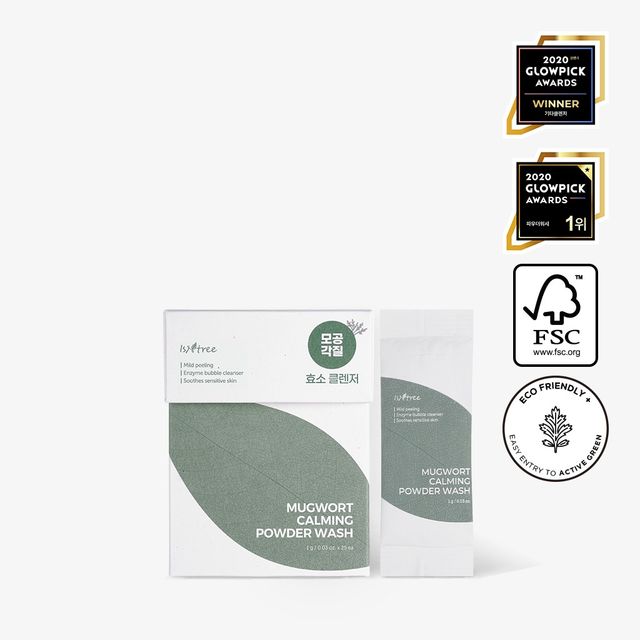
Mugwort Calming Powder Wash is a different kind of product. It rinses off and it has eleven ingredients. Mugwort leaf powder sits eighth at 4,000ppm, and there is no fragrance.
Here the actual worker is papain rather than mugwort. It is a protein digesting enzyme that loosens surface cells. And papain carries no amount. On this label the number belongs to the mugwort while the work belongs to the enzyme.
The page says mildly acidic and prints no pH. Sodium palmitate sits third and is a soap salt, which does not sit perfectly with that wording. What an enzyme powder actually does is in enzyme powder cleansers.
Common questions
Is mugwort a better soothing ingredient than centella?
No trial has compared them on human skin. The multiple on the front came from a dish, against the same company's own material. What can be said now is that centella has far more research and far more labels behind it.
Is young mugwort better than ordinary mugwort?
Young mugwort and Ganghwa medicinal mugwort are marketing names. The ingredient list says Artemisia argyi. Harvest timing changing a plant's composition is botanically plausible, but we found nothing measuring that difference on skin.
Is it fine for sensitive skin?
Mugwort itself is not classed as an irritant. But the Asteraceae allergy point applies, and three of the products above carry fragrance. On reactive skin the whole list answers this better than the word soothing on the front.
Is it safe during pregnancy?
We have not seen a pregnancy caution attached to topical mugwort cosmetics. That is a gap rather than a clearance, and eaten forms are a separate conversation. The ingredient to check is usually something else in the same bottle.
What is the difference between leaf powder and leaf water?
Powder is dried and ground leaf, and leaf water is the steeped liquid. In a rinse off product the powder also does physical work. In a leave on product, the big number almost always belongs to the leaf water.
If you are holding something with mugwort on the front and cannot tell whether the number belongs to the leaf water or the extract, send us the product page. We will find both entries for you.
Products mentioned
Hanyul
Pure Artemisia Calming Water Cream
We checked 15 lines this product advertises against the ingredient list and public documents. None of them hold up on their own. They are partly right at best.
9likely3no evidence3says nothing
See the label check (15 lines)
Claims translated from Korean, originals preserved.
- After 30 minutes of use, trouble*** reddened by physical stimulation decreased by -66%
Korean original
사용 30분 후, 물리적 자극으로 -66% 붉어진 트러블*** 감소
- Immediately after use, dry trouble** improved +100 %
Korean original
사용 직후 건조 트러블 ** +100 % 개선
- After 2 weeks, bumpy irregularities (texture) improved +10 %
Korean original
2주 후 울퉁불퉁 요철(결) +10 % 개선
- From Korean local ingredients, we only included young mugwort around Dano, which has good soothing efficacy among Ganghwa medicinal mugwort.
Korean original
한국 로컬 원료, 강화약쑥 중에서도 진정 효능이 좋은 단오 무렵의 어린쑥만 담았어요.
- Without added water, extracted from 100% #DomesticCultivation mugwort, #Denser moisturizing extract
Korean original
물 타지 않고 #국내재배 100% 쑥 에서 뽑아 #더 진한 보습 액기스
- '3 days' after, moisture hydration lasting '3 times' longer
Korean original
'3일' 후에도 '3배' 더 오래 지속되는 수분 보습력
- Sensitive oily dehydrated skin, acne-prone skin can also be used
Korean original
민감 수부지, 여드름성 피부도 사용 가능
- After 1 hour of use, skin barrier recovery appeared at +113%.
Korean original
사용 1시간 후 피부 장벽 회복이 +113%로 나타났습니다.
- Immediately after use, satisfaction responses were 'spreads smoothly' 100%, 'feels like oil-water balance is right' 93%, 'fresh yet moist finish' 93% (30 adult women, 2022.11.28~12.21, P&K Skin Clinical Research Center).
Korean original
사용 직후 만족도에서 '부드럽게 발린다' 100%, '유수분 밸런스가 맞춰진 것 같다' 93%, '산뜻하면서도 촉촉한 마무리' 93%로 응답했습니다(성인 여성 30명, 2022.11.28~12.21, 피엔케이피부임상연구센타).
- Soothing effect X4 times stronger than cica, the soothing powerhouse
Korean original
진정 강자 시카보다 X4배 강한 진정 효과
- The soothing ingredient Eupatilin found from mugwort
Korean original
쑥에서 찾은 진정 성분 유파틸린
- Sensitivity panel test completed, dermatology test completed, allergy test completed, acne-prone skin suitability test completed
Korean original
민감성 패널 테스트 완료 피부과 테스트 완료 알러지 테스트 완료 여드름성 피부 사용 적합성 테스트 완료
- Catches inner dryness and solves trouble* and even soothes with # trouble-ending cream
Korean original
속건조 잡고 트러블 * 진정까지 해결하는 # 트러블 종결크림
- * Dryness, temporary redness caused by external irritation, sensitivity, pigmentation, bumpy skin
Korean original
* 건조, 외부 자극으로 인한 일시적 붉은기, 민감, 색소 침착, 울퉁불퉁 피부
- Trouble-soothing special ingredient Ssuk Cica ™
Korean original
트러블 진정 특효 성분 쑥시카 ™
Hanyul
Pure Artemisia Calming Pad
We checked 9 lines this product advertises against the ingredient list and public documents. 2 of them hold up. The rest are only partly right or have nothing behind them.
2backed1likely1partly backed4overstated1no evidence
See the label check (9 lines)
Claims translated from Korean, originals preserved.
- *Compared to our own Centella Asiatica extract, in-vitro test result
Korean original
*자사 병풀추출물 대비, in-vitro 시험결과
- 1)in-vitro test result 2)Geographical indication No. 16, stated as Hwanghae mugwort in the full ingredient list
Korean original
1)in-vitro 시험 결과 2)지리적 표시제 16호, 전성분에서는 황해쑥으로 표기
- A double-sided pad specialized in soothing and moisture
Korean original
진정과 수분 에 특화된 양면 패드
- Through 15 processes, we extracted Eupatilin, a soothing special-effect ingredient with a 9 times 1) increased absorption rate, from 100% domestically grown Ganghwa mugwort 2).
Korean original
15번의 공정으로 추출해 9배 1) 흡수율을 높인 진정 특효 성분 유파틸린을 국내 재배 100% 강화약쑥 2) 에서 추출했어요
- A moist soothing essence pad that cares for trouble** soothing and inner moisture at once with Ssukcica ™, 4 times* stronger than cica.
Korean original
시카보다 4배* 강한 쑥시카 ™ 로 트러블** 진정과 속수분을 한번에 케어하는 촉촉한 진정 에센스 패드
- Within 5 minutes, quickly soothe trouble ** by 77 %
Korean original
5분만에 빠르게 트러블 ** 77 % 진정
- Immediately after use, redness *** -53 %
Korean original
사용 직후 붉은기 *** -53 %
- A low-irritation pad that can be used comfortably even for sensitive skin
Korean original
예민해진 피부도 편안하게 사용 가능한 저자극 패드
- ** Improves damaged skin barrier
Korean original
** 손상된 피부 장벽 개선
HANYUL
Artemisia Hydrating Serum
We checked 3 lines this product advertises against the ingredient list and public documents. None of them hold up on their own. They are partly right at best.
1partly backed1overstated1no evidence
See the label check (3 lines)
Claims translated from Korean, originals preserved.
- As a result of a human application test, it was confirmed that it reduces oil by 42% and increases moisture by 137%, improving the oil-moisture balance.
Korean original
인체적용시험 결과 유분은 42% 감소시키고, 수분은 137% 올려 유수분 밸런스가 개선되는 효과를 확인했다.
- It possesses 34% stronger moisture power than hyaluronic acid, and is a new-concept moisture line that catches excess oil and improves even inner dryness.
Korean original
히알루론산보다 34% 강한 수분력을 지녔으며 과잉 유분을 잡아 속건조까지 개선하는 신개념 수분 라인이다.
- As the moisture-coating capsule bursts, it forms a moisture protective film, enhancing moisture retention.
Korean original
수분코팅캡슐이 터지면서 수분 보호막을 형성해 수분 지속력을 높여준다.
Isntree
Mugwort Calming Powder Wash
We checked 5 lines this product advertises against the ingredient list and public documents. None of them hold up on their own. They are partly right at best.
1likely2partly backed1overstated1no evidence
See the label check (5 lines)
Claims translated from Korean, originals preserved.
- If you use Mugwort Powder Wash at the deep cleansing step about 1 to 2 times a week, unnecessary flake care is possible along with sebum removal.
Korean original
쑥 파우더 워시는 주1~2회 정도 딥 클렌징 단계에 사용해주시면 피지 제거와 더불어 불필요한 각질 케어가 가능합니다.
- #EnzymePowder #FlakesScrubbedAway
Korean original
#효소파우더 #각질쑥싹
- In the case of Mugwort Powder Wash, it is formulated weakly acidic so it can be used gently, but its cleansing power may be somewhat insufficient to remove all makeup products.
Korean original
쑥 파우더 워시의 경우 약산성으로 처방되어 순하게 사용이 가능하나 메이크업 제품을 모두 지우기에는 세정력이 다소 부족할 수 있습니다.
- Mugwort Powder Wash contains papain enzyme and is a weakly acidic cleansing product effective at removing unnecessary flakes and impurities, and it is a product you may use every day.
Korean original
쑥 파우더 워시는 파파인 효소가 함유되어 불필요한 각질과 노폐물을 제거하는 데 효과적인 약산성 클렌징 제품으로 매일 사용하셔도 무방한 제품입니다.
- Papain enzyme is contained about 3 times higher than in an ordinary powder wash, so you can feel a smooth skin texture with just one use, and you may also lather it on areas that need flake care, leave it on for 30 seconds and use it as a foam pack.
Korean original
파파인 효소가 일반 파우더 워시대비 3배가량 높게 함유되어 한번에 사용 만으로도 매끄러운 피부결을 느끼실 수 있으며 각질관리가 필요한 부위에 거품을 내어 30초간 올려놓고 거품팩으로 활용하셔도 좋습니다.