HANYUL
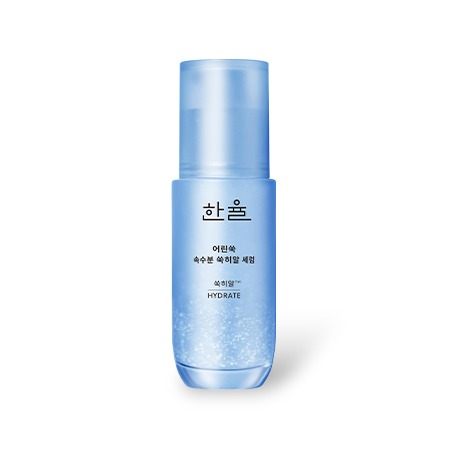
HANYUL Artemisia Hydrating Serum
Ingredient analysis and how the ad lines read
Read on 2026-09-07
What is this product?
Hanyul's Artemisia Hydrating Serum is aimed at oily skin that is still dehydrated, and its distinguishing feature is a printed level where a name would normally stand alone: 황해쑥잎수 at 10,554 ppm, about 1.06 percent, sixth of 35 ingredients. The name gives hyaluronic acid equal billing, but the label does not, listing 100 ppm of hyaluronic acid and 1.5 ppm of sodium hyaluronate, roughly 104 times less than the mugwort. A fragrance entry is printed 17th, so it is the wrong pick for anyone avoiding scent.
What makes it different?
Two brand figures need separating, because they are not the same kind of evidence. Hanyul reports a human application test on this serum with oil down 42 percent and moisture up 137 percent, a well chosen pair of endpoints, but publishes no participant count, no duration and no control arm, so neither number can be checked. The 34 percent stronger hydration figure attached to the line is a different animal: the brand's own footnote ties it to an in vitro test against hyaluronic acid alone, which is one raw material beating another in a dish rather than anything this serum did on skin. What the ingredient list does back is the oily-skin framing, with inositol, the ingredient credited for controlling oil, printed 28th and a light barrier group of ceramide NP, phytosterols and hydrogenated lecithin behind it.
What is in it?
The full ingredient list as the brand publishes it, in the printed order. Each name links to what we know about that ingredient.
This brand publishes its ingredient list in Korean only. Names below are the matching INCI names from the Korean Cosmetic Association ingredient dictionary.
Key ingredientWorth a closer look
- Water
- Butylene Glycol
- Glycerin
- 1,2-Hexanediol
- Sodium Acrylates Crosspolymer-2
- Artemisia Argyi Leaf Water
- Xylitol
- Diethoxyethyl Succinate
- Isopentyldiol
- PPG-13-Decyltetradeceth-24
- Ammonium Acryloyldimethyltaurate/Beheneth-25Methacrylate Crosspolymer
- Betaine
- Sphingomonas Ferment Extract
- Ceramide NP
- Arachidyl Alcohol
- Ethylhexylglycerin
- Fragrance
- Stearic Acid
- Phytosterols
- Behenyl Alcohol
- Arachidyl Glucoside
- Sodium Metaphosphate
- Hydrogenated Lecithin
- Arginine
- Aspartic Acid
- Glutamic Acid
- Hyaluronic Acid
- Inositol
- Cetearyl Alcohol
- Lactobacillus Ferment
- Maltodextrin
- Hydrolyzed Gardenia Florida Extract
- Propylene Glycol
- Sodium Hyaluronate
- Tocopherol
Ingredients with no mark are ones we found nothing notable about, and when marks overlap on one ingredient we show the caution first.
We could not place these in the list above: 스테아릭애씨드, 하이드로제네이티드레시틴, 아라키딜글루코사이드, 세테아릴알코올
Did the ad claims hold up?
We checked 3 lines this product advertises against the ingredient list and public documents. None of them hold up on their own. They are partly right at best.
Claims translated from Korean, originals preserved.
partly backed1
- As a result of a human application test, it was confirmed that it reduces oil by 42% and increases moisture by 137%, improving the oil-moisture balance.
Korean original
인체적용시험 결과 유분은 42% 감소시키고, 수분은 137% 올려 유수분 밸런스가 개선되는 효과를 확인했다.
overstated ad line1
- It possesses 34% stronger moisture power than hyaluronic acid, and is a new-concept moisture line that catches excess oil and improves even inner dryness.
Korean original
히알루론산보다 34% 강한 수분력을 지녔으며 과잉 유분을 잡아 속건조까지 개선하는 신개념 수분 라인이다.
no evidence1
- As the moisture-coating capsule bursts, it forms a moisture protective film, enhancing moisture retention.
Korean original
수분코팅캡슐이 터지면서 수분 보호막을 형성해 수분 지속력을 높여준다.
Each line is quoted as the brand published it, and each one was read on its own against the ingredient list and the documents the brand publishes.
Which articles cover it?
Articles on this site that write about this product.