Fragrance-free, with sixteen essential oils on the list
Fragrance-free usually means one word is absent from the ingredient list. 42 of the 417 fragrance-free products we read still carry scented botanical oils.
Fragrance-free almost always means one specific thing: the word 향료, meaning fragrance, does not appear on the ingredient list.
That is a real and checkable fact. It is also much narrower than what people think they are buying.
Of the products we read, 417 have no fragrance entry. 42 of those still carry essential oils, which are scented botanical materials that a fragrance entry would have covered if the brand had chosen to blend them as a perfume instead. That is roughly one in every ten fragrance-free products.
The most extreme case we found is a cream with sixteen essential oils and three declared fragrance allergens, and no fragrance entry anywhere on its 108 item list.
Why does this happen?
Because 향료 is a labelling category, not a description of smell.
When a brand buys a blended perfume compound from a fragrance house, it declares the whole thing as 향료, one entry. When a brand instead adds lavender oil, bergamot oil and rosemary oil individually, each is declared by its own name and none of them is 향료.
The skin does not know the difference. Lavender oil contains linalool, citrus peel oils contain limonene, and those are among the most common contact allergens in cosmetics regardless of which label entry they arrived under.
There is a second consequence worth knowing. Korean labelling requires certain fragrance allergens to be declared separately once they pass a threshold. So a product can be fragrance-free by the 향료 test and still print limonene, linalool and citral on the same list, which is exactly what the first product below does.
And the flag runs the other way too. A product can be marked as fragranced because it carries a single essential oil, with no 향료 entry at all. Fragranced and fragrance-free are both shorthand, and the ingredient list is the only thing that settles it.
Centellian24 Madeca Cream Time Reverse
The clearest example we have found of the gap between the phrase and the list.
There is no fragrance entry in 108 ingredients. We searched for it and it is genuinely not there.
Then read positions 88 to 105. Sixteen essential oils in a row: olive oil, orange oil, calamansi peel oil, lavender oil at 92, bergamot oil at 93, rosemary leaf oil at 94, orange peel oil at 95, and then litsea, cedar, mandarin peel, atlas cedar bark, scented geranium flower, jasmine, rose flower, galbanum resin and copaiba balsam.
And then the last three entries on the whole list: limonene at 106, linalool at 107, citral at 108. Those are declared allergens, and they are there because the oils above them brought them.
So this product is fragrance-free by the only test the phrase describes, and it carries a perfumer's palette plus three notified allergens. Both statements are true at the same time, which is the point of this article.
The rest of the label is worth reading too. Madecassic acid is seventeenth at a disclosed 4,800 parts per million, which is 0.48 percent, inside the range topical centella work uses, with a dozen centella derived entries clustered around it. That is a real, checkable inclusion and it is the reason to buy the cream.
The time reverse framing is not. Retinol is at position 76 of 108, behind the preservative and chelator block, with no amount disclosed. At that position a working retinol level is not plausible. Note also that the retinol is what puts this cream on the pregnancy caution list.
Fragrance entry: none. Essential oils: 16, plus three declared allergens Disclosed: madecassic acid at 0.48 percent
Mediheal Tea Tree Derma Serum
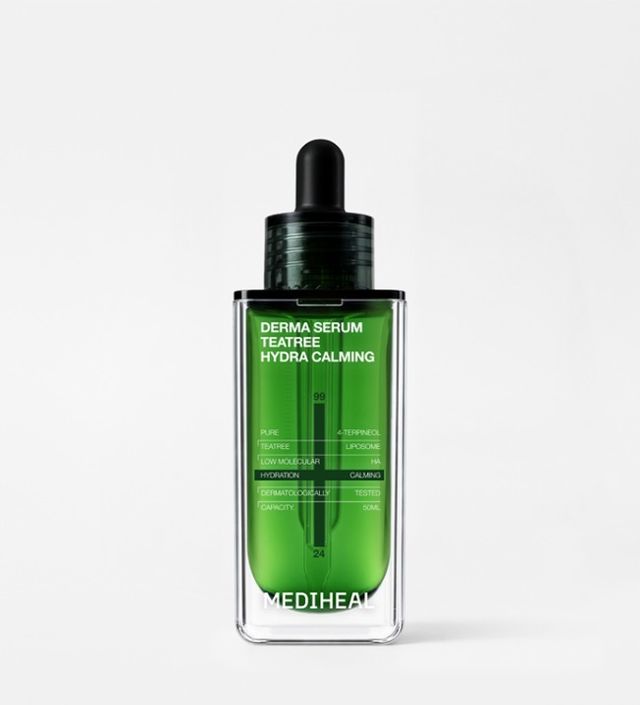
The same structure, and the rare case where the essential oil load is quantified.
No fragrance entry. Tea tree leaf oil is eighteenth of 31 at a disclosed 300 parts per million, and 4-terpineol, tea tree oil's principal active constituent, is separately printed at 25 at 20 parts per million.
Being able to see the oil load as a number instead of guessing at it from a position is unusual and genuinely useful. If you avoid essential oils because of allergen risk, 300 parts per million is a figure you can reason about, which is more than the other four products here give you.
Read the tea tree figures in the right order though. The biggest number on this label is tea tree leaf water at sixth, at 38,800 parts per million. A hydrosol is the weakest of the tea tree materials, essentially water carrying a trace, so the largest figure belongs to the least concentrated form. Tea tree leaf extract at 22 is at 100 parts per million and tea tree extract at 23 is at 90.
The hydration half of this serum is well built: three glycols high on the list, betaine ninth, panthenol tenth, sodium hyaluronate eleventh. The high purity tea tree claim is the weak one, because purity is a statement about raw material grade, chemotype and terpinen-4-ol fraction, and none of that is stated.
Fragrance entry: none. Essential oils: 1, disclosed at 300 parts per million
Bring Green Tea Tree Cica Soothing Toner
A very short list, which makes the placement impossible to miss.
Seventeen ingredients. Tea tree extract is first, ahead of water. Tea tree flower/leaf/stem extract is seventh, and tea tree leaf oil is eighth, which is high in a list this short. There is no fragrance entry.
An essential oil at position eight of seventeen on a product sold for soothing irritated skin is worth pausing on. It is not a trace at the end of the list. And this product's own caution field names the tea tree oil alongside betaine salicylate as a pregnancy consideration.
The brand's most credible sentence is the one not selling anything: a note that the high tea tree content may produce a white sediment. That is a real consequence of a genuinely large botanical fraction, and it is corroborated by the extract sitting ahead of water.
One claim does not survive. The page describes an AHA tidying keratin and sebum. The only candidate is citric acid at thirteen, sitting directly after sodium citrate at twelve. That pairing is a pH buffer, not an exfoliant. The actual keratolytic on this label is betaine salicylate at fifteen, which the copy does not mention.
Fragrance entry: none. Essential oils: 1, at position 8 of 17
Cellology Blue Eraser Serum
A soothing serum whose tail is a terpene stack.
No fragrance entry. Four essential oils: eucalyptus leaf oil at 42 of 59, patchouli oil at 47, clary sage oil at 54 and rosemary leaf oil at 55. Menthol sits at 34.
This is the pattern to recognise once you know it exists. The oils are all in the last third, which bounds them below one percent, so this is a small aromatic load rather than a large one. That is genuinely different from the Bring Green toner above, where the oil is eighth of seventeen.
Position is the thing to read when no figure is given, and in this category it is often the only signal you get. Four oils at the end of a 59 item list is a scent and a small one. One oil at position eight of seventeen is a design decision.
Menthol at 34 is a separate consideration. It produces a cooling sensation that people read as calming, and that sensation is not the same as reduced inflammation.
The page carries a number one claim for immediate soothing with no named scope, period or measure, so there is nothing in it to check.
Fragrance entry: none. Essential oils: 4, all in the final third
LAGOM Gel To Water Cleanser
Included because it fails in the opposite direction, and it is the more common failure.
The page says the product is close to unscented. Fragrance is printed at position 14 of 20.
Strictly the two statements are not a contradiction, because close to unscented is a claim about perceived intensity rather than about composition, and a lightly dosed fragrance can smell faint. But a reader who avoids fragrance is not helped by being told a product is nearly unscented. They need to know whether the entry is on the list, and it is.
Everything else about this cleanser is reasonable for its stated audience. There is no soap pair, no sulfate and no ethanol, and three humectants sit in the top six. A 24 and 48 hour patch test judged it non irritating, which supports the sensitive skin positioning.
That is exactly why the fragrance matters here. Dry and compromised barrier skin overlaps heavily with fragrance reactive skin, and fragrance is the single most common trigger cited by the people who choose products off a sensitivity label.
Fragrance entry: yes, at position 14 of 20
How to actually check this
Search the ingredient list for the fragrance entry first. If it is absent, the product is fragrance-free in the only sense the phrase has.
Then read the last third of the list for oils. Anything ending in oil that names a flower, a leaf, a peel or a resin is an essential oil: lavender, bergamot, rosemary, tea tree, patchouli, geranium, citrus peels. Plain plant oils like sunflower, jojoba and squalane are different, they are emollients rather than aromatics.
Look for the declared allergens at the very end. Limonene, linalool, citronellol, geraniol, citral and coumarin are the common ones. If they are printed, something aromatic is in the formula regardless of what the front of the box says, and on one product here they are the final three entries of 108.
Weigh the position when no figure is given. An oil at the tail of a long list is a scent. An oil in the top half of a short list is a formulation choice.
And do not read fragrance-free as gentle. It removes one common trigger and says nothing about acids, alcohols, or the botanicals that replaced the perfume. A free-from list that omits the aroma system actually in the bottle is the shape to watch for, which we set out in free-from claims. If you are building a routine around reactive skin, routine by subtraction is the method we would use, and fragrance-free picks covers products that pass both tests.
Common questions
Are essential oils worse than synthetic fragrance?
Not as a rule, and in some cases the opposite. A blended fragrance compound is one label entry covering many materials you cannot see. Essential oils are named individually, so you can actually tell what is in there. The risk comes from the specific molecules, and lavender, bergamot and citrus peels are among the more common sensitisers in both routes.
Why do brands use essential oils in products for sensitive skin?
Because many of them have traditional soothing associations, and because the resulting product can be marketed as fragrance-free. Both reasons are real, and neither is evidence the oils are gentle.
Does unscented mean the same as fragrance-free?
No. Unscented sometimes means a masking fragrance has been added to cover a raw material smell, which is still a fragrance entry. Fragrance-free is the more specific term, and it is the one you can check against the list.
Is an essential oil at the end of the list a problem?
For most people, no. A late position bounds it below one percent and often far below. For someone with a diagnosed contact allergy to that specific molecule, position does not make it disappear, and the declared allergen entries at the end of the list are the ones to read.
How do I tell an essential oil from a plant oil?
Essential oils are volatile aromatic extracts, usually from flowers, leaves, peels or resins, and they smell strongly. Plant oils like sunflower, jojoba, argan and squalane are fatty emollients with little smell. Both say oil on the label and they do completely different jobs.
If you have a product labelled fragrance-free and cannot tell whether it carries essential oils, send us the listing and we will read the last third of the list with you.
Products mentioned
Centellian24
Centellian24 Madeca Cream Time Reverse
We checked 4 lines this product advertises against the ingredient list and public documents. One of them holds up. The rest are only partly right or have nothing behind them.
1backed2overstated1no evidence
See the label check (4 lines)
Claims translated from Korean, originals preserved.
- Madeca
Korean original
마데카
- Time Reverse
Korean original
타임 리버스
- (*Active-TECA™)
Korean original
(*활성-TECATM)
- [#1 Soothing]
Korean original
[1등 진정]
Mediheal
Mediheal Tea Tree Derma Serum
We checked 5 lines this product advertises against the ingredient list and public documents. None of them hold up on their own. They are partly right at best.
2partly backed3no evidence
See the label check (5 lines)
Claims translated from Korean, originals preserved.
- Tea Tree
Korean original
티트리
- Moisture Soothing Serum
Korean original
수분진정세럼
- Upgrade
Korean original
업그레이드
- High Purity Tea Tree
Korean original
고순도 티트리
- Fast Soothing
Korean original
빠르게 진정
Bring Green
Tea Tree Cica Soothing Toner
We checked 4 lines this product advertises against the ingredient list and public documents. One of them holds up. The rest are only partly right or have nothing behind them.
1backed1partly backed1overstated1no evidence
See the label check (4 lines)
Claims translated from Korean, originals preserved.
- *Because it contains a large amount of tea tree, a white sediment may form, but there is nothing wrong with the quality, so it is fine to use.
Korean original
*티트리 성분 다량 함유로 하얀색 침전물이 생길 수 있으나, 품질에는 이상이 없으므로 사용하셔도 무방합니다.
- With triple tea tree and cica, it solves the troubles of angry skin.
Korean original
3중 티트리와 시카 함유로 성난 피부 고민을 해결해 줍니다.
- The AHA component tidies up dead skin cells and sebum.
Korean original
AHA 성분으로 각질과 피지를 정돈해 줘요.
- It is a reassuring product that has completed the TEST for suitability for use on acne-prone skin.
Korean original
여드름성 피부 사용 적합 TEST를 완료한 안심 제품입니다.
Cellology
Cellology Blue Eraser Serum
We checked 3 lines this product advertises against the ingredient list and public documents. One of them holds up. The rest are only partly right or have nothing behind them.
1backed1no evidence1says nothing
See the label check (3 lines)
Claims translated from Korean, originals preserved.
- Completed functional cosmetics review (or report) under the Cosmetics Act.
Korean original
화장품법에 따른 기능성 화장품 심사(또는 보고)를 필함
- [Dermatology/Pharmacy Entry] Instant Calming NO.1 Serum
Korean original
[피부과/약국 입점] 즉각 진정 NO.1 세럼
- Blue Eraser
Korean original
블루 이레이저
LAGOM
Gel To Water Cleanser
We checked 13 lines this product advertises against the ingredient list and public documents. 2 of them hold up. The rest are only partly right or have nothing behind them.
2backed7partly backed2overstated2no evidence
See the label check (13 lines)
Claims translated from Korean, originals preserved.
- A gel type morning cleanser
Korean original
젤 타입 아침 클렌저
- Texture: a bouncy gel texture, colourless and transparent.
Korean original
제형 : 탱글한 젤 제형으로 무색 투명해요.
- A bubble-free gel cleanser containing 85% skincare ingredients
Korean original
스킨케어 성분 85% 함유 버블프리 젤 클렌저
- Main functions: ultra sensitive | moisture care
Korean original
주요 기능 초민감성ㅣ수분케어
- Recommended type & texture: dry skin
Korean original
추천 타입 & 제형 건성 피부
- A gel to water type morning moisturising cleanser
Korean original
젤 투 워터 타입 아침 보습 클렌저
- It has completed a low irritation test too, so it will be no burden to use every morning.
Korean original
저자극 테스트도 완료했으니 매일 아침 사용하기에 부담이 없을 거예요.
- Test result: judged non-irritating in a 24-hour/48-hour patch test
Korean original
시험 결과 : 24시간/48시간 첩포테스트 결과 비자극성으로 판정
- Note: it is also good as a first wash for light face makeup or sunscreen. However, for point makeup such as mascara, please use a dedicated remover.
Korean original
유의사항 : 가벼운 피부 화장이나 선크림의 1차 세안용으로도 좋아요. 단, 마스카라 등 포인트 메이크업은 전용 리무버를 사용해 주세요.
- A moisture filling morning cleanser
Korean original
수분 채움 아침클렌저
- Fragrance: close to fragrance free.
Korean original
향 : 거의 무향에 가까워요.
- 85% skincare ingredients
Korean original
스킨케어 성분 85%
- 99% pore impurity cleansing
Korean original
99% 모공노폐물 세정