Isntree
Isntree Mugwort Calming Powder Wash
Ingredient analysis and how the ad lines read
Read on 2026-09-05
What is this product?
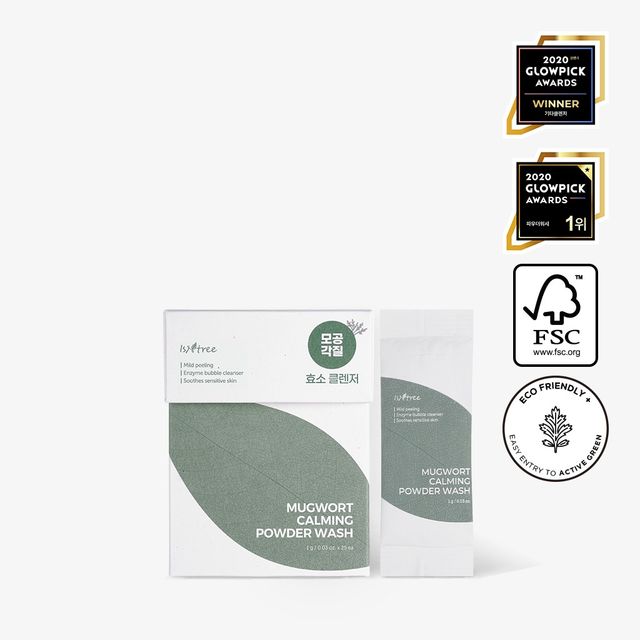
Isntree Mugwort Calming Powder Wash gives you exactly one dose per wash: twenty-five sealed 1 g sachets, with the same powder also sold in a 15 g tub. The brand sells it on having three times the enzyme of an unnamed rival powder wash, but 파파인 is printed sixth of the label's eleven entries with no amount at all, and the only quantity published belongs to the mugwort instead (쑥잎가루 4,000 ppm); its surfactants are gentler than most powder washes, though 소듐팔미테이트 sits third and is a soap salt, and Isntree publishes no pH, so the repeated 약산성 wording is a word rather than a measurement.
What makes it different?
Two things set it apart. The unit of sale is the first: 25 single-dose 1 g sachets instead of a tub fix how much you use and keep the rest dry, and portability and hygiene are nearly as much of what buyers praise as the enzyme is. The second is the shape of the label, unusual in the opposite direction from this category: the only quantity Isntree prints belongs to a supporting botanical rather than to the enzyme the marketing is built on, so the headline 3배 claim is a ratio with neither side published. Skip it if your skin is dry, sensitive to soap or reactive to daisy-family plants, and do not count on it to take off long-wear makeup on its own.
What is in it?
The full ingredient list as the brand publishes it, in the printed order. Each name links to what we know about that ingredient.
This brand publishes its ingredient list in Korean only. Names below are the matching INCI names from the Korean Cosmetic Association ingredient dictionary.
Key ingredient
- Zea Mays (Corn) Starch
- Sodium Cocoyl Isethionate
- Sodium Palmitate
- Sodium Lauroyl Glutamate
- Diglycerin
- Papain
- Sea Salt
- Artemisia Princeps Leaf Powder
- Allantoin
- Maltodextrin
- Water
Ingredients with no mark are ones we found nothing notable about, and when marks overlap on one ingredient we show the caution first.
Did the ad claims hold up?
We checked 5 lines this product advertises against the ingredient list and public documents. One of them looks likely, though none are proven outright.
Claims translated from Korean, originals preserved.
likely, not proven1
- If you use Mugwort Powder Wash at the deep cleansing step about 1 to 2 times a week, unnecessary flake care is possible along with sebum removal.
Korean original
쑥 파우더 워시는 주1~2회 정도 딥 클렌징 단계에 사용해주시면 피지 제거와 더불어 불필요한 각질 케어가 가능합니다.
partly backed2
- #EnzymePowder #FlakesScrubbedAway
Korean original
#효소파우더 #각질쑥싹
- In the case of Mugwort Powder Wash, it is formulated weakly acidic so it can be used gently, but its cleansing power may be somewhat insufficient to remove all makeup products.
Korean original
쑥 파우더 워시의 경우 약산성으로 처방되어 순하게 사용이 가능하나 메이크업 제품을 모두 지우기에는 세정력이 다소 부족할 수 있습니다.
overstated ad line1
- Mugwort Powder Wash contains papain enzyme and is a weakly acidic cleansing product effective at removing unnecessary flakes and impurities, and it is a product you may use every day.
Korean original
쑥 파우더 워시는 파파인 효소가 함유되어 불필요한 각질과 노폐물을 제거하는 데 효과적인 약산성 클렌징 제품으로 매일 사용하셔도 무방한 제품입니다.
no evidence1
- Papain enzyme is contained about 3 times higher than in an ordinary powder wash, so you can feel a smooth skin texture with just one use, and you may also lather it on areas that need flake care, leave it on for 30 seconds and use it as a foam pack.
Korean original
파파인 효소가 일반 파우더 워시대비 3배가량 높게 함유되어 한번에 사용 만으로도 매끄러운 피부결을 느끼실 수 있으며 각질관리가 필요한 부위에 거품을 내어 30초간 올려놓고 거품팩으로 활용하셔도 좋습니다.
Each line is quoted as the brand published it, and each one was read on its own against the ingredient list and the documents the brand publishes.
What else is worth seeing?
Products we read alongside this one.
Which articles cover it?
Articles on this site that write about this product.
- On a mugwort label, the big number is leaf waterMugwort appears on 63 Korean labels and six print an amount. Four share one shape, with the leaf water and the extract more than three thousandfold apart.
- What does an enzyme powder cleanser actually do?The enzyme cuts protein. Sebum is not protein. Nine of nineteen Korean powder cleansers print an enzyme level, and the surfactant is doing most of the work.