What ectoin actually does, and how much Korean labels put in
Ectoin appears on 106 Korean labels and eight of them print a level. Those eight sit a thousandfold apart, and only the top one reaches the trial concentration.
Short answer: ectoin is a molecule that microbes living in extreme places make to protect themselves, it handles water differently from hyaluronic acid, and it has only recently started appearing on Korean labels.
We read 106 Korean labels carrying ectoin. Eight of them print a level. The other 98 give you the name and nothing else.
That part is ordinary for a new ingredient. What is worth looking at is how far apart those eight sit.
What is ectoin?
It was found in 1985 in a salt lake in the Egyptian desert. Water that salty pulls water out of the cells living in it, so the microbes there build up a substance that keeps their proteins and membranes intact under that pressure. That class of substance is called an osmolyte, and ectoin is one of them.
The mechanism story comes from there. Ectoin gathers water molecules around itself and holds them in an ordered layer, and that layer is described as wrapping proteins and cell membranes so their structure holds.
How this differs from hyaluronic acid matters in practice.
- Hyaluronic acid is a large polymer. It pulls a lot of water in and holds it at the surface.
- Ectoin is a small molecule. It is described as arranging water that is already there rather than gathering more of it.
So the two are not competing for the same job, which is why they often sit in the same bottle. Why hyaluronic acid sometimes works against you is in why hyaluronic acid can leave skin tighter.
Has any of this been shown in people?
Yes, and the boundaries of that yes are the useful part.
What holds. Sixty five patients with mild to moderate atopic dermatitis applied an ectoin cream and a comparator cream to two symmetrical lesions for 28 days. The comparator was a nonsteroidal anti inflammatory cream, and the two came out equivalent. Tolerability was good.
What also holds. A trial in 70 children aged 2 to 18 compared a cream containing 1 percent ectoin and 0.1 percent hyaluronic acid against the vehicle cream alone, twice daily for four weeks. At 28 days the ectoin arm showed greater improvement.
What is real but is not about your face. A 2026 cell study put ectoin on human keratinocytes and fibroblasts, with and without UVB, and tracked hydration related genes and a collagen degrading enzyme. That happened in culture dishes. It is not a statement about what a cream does on a face.
Two things follow.
First, both human trials were run in people with atopic dermatitis. That means a barrier that was already broken got help recovering. It does not say the same size of change appears on healthy skin.
Second, the first trial never published the ectoin concentration in the cream it used. The abstract names a product code and nothing more. So the only human trial here that names a concentration is the pediatric one, at 1 percent.
Carry that number to the shelf and the picture changes.
What the labels actually print
Here are four of the eight that print an amount, lowest first.
Ectoin Sun Cushion prints ectoin at 100ppm, which is 0.01 percent.
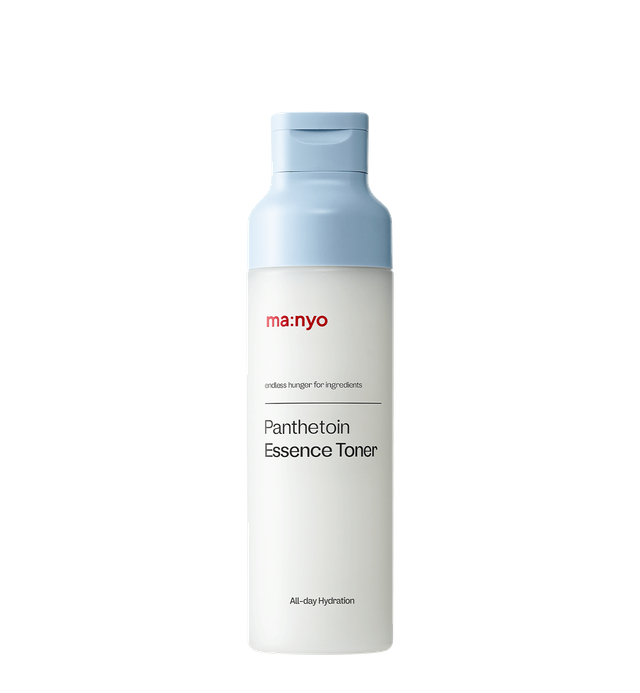
Panthetoin Essence Toner prints panthenol at 4,000ppm and ectoin at 1,000ppm. The product name is the brand's own name for that pairing.
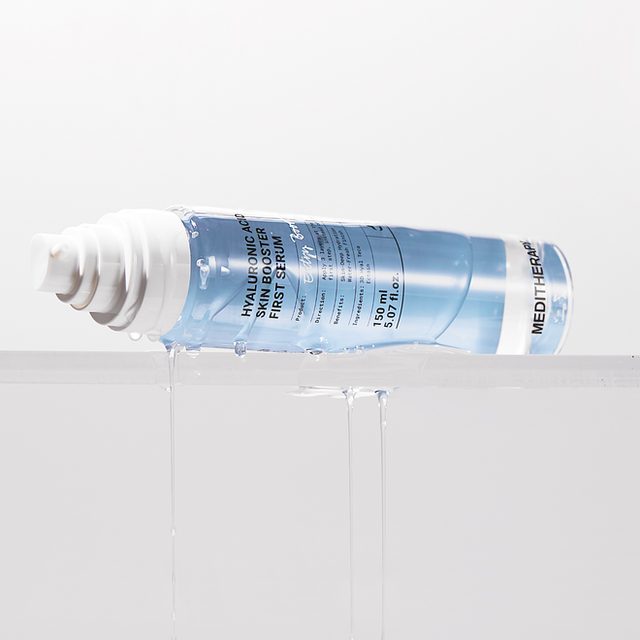
Hyaluronic Acid Skin Booster First Serum prints ectoin at 5,000ppm.
Ectoin Cica Essence Toner prints ectoin at 1 percent, which is 10,000ppm.
Even these four sit a hundredfold apart, bottom to top. The other four print 10ppm twice, 51ppm and 5,000ppm, so across all eight the spread is a thousandfold. And of the eight, only the last one here reaches 1 percent, the single concentration a human trial here puts a number on.
None of that means the others do nothing. It means nothing has been published about what they do at those amounts. Those are different sentences.
Putting the ingredient in the name does not mean telling you more
Five products carry ectoin in the name: the sun cushion and the essence toner above, plus a lotion, an emulsion and a tone up sun serum.
Four of them print an amount, which is genuinely good news. Naming an ingredient on the front and printing no number for it is far more common.
But those four are 10ppm, 100ppm, 5,000ppm and 1 percent. Same badge on the front, a thousandfold apart inside. It is hard to find a cleaner pair for showing that an ingredient name on the front guarantees nothing about how much is in there. How to count the same problem on other ingredients is in the ppm the brand printed itself.
Product by product
Ectoin Cica Essence Toner discloses more than most. Across 28 ingredients there is no fragrance, no essential oil, no drying alcohol and no exfoliating acid. Four centella derivatives and five ceramide species sit alongside the ectoin, so the water holding side and the lipid side are both covered.
The gap is outcome. No test result exists for this toner. And four fixed plant oils including meadowfoam and canola sit late in the list, which is worth knowing if you screen for fungal acne triggers.
Hyaluronic Acid Skin Booster First Serum is a case of the name and the numbers pointing different ways. The brand breaks the hyaluronic family into four separate entries and prints a figure for each, and all four together come to 1,185ppm. Ectoin, which the name never mentions, is at 5,000ppm. The biggest number in the bottle belongs to the ingredient the product is not named after.
Read the skin booster wording carefully. That term comes from injectable treatments that place hyaluronic acid under the skin, and nothing spread on top does that.
The page also carries an absorption figure of 2.47 times and a penetration depth of 2.5mm. Neither comes with an institution, a participant count or a date. Treat both as brand statements.
Panthetoin Essence Toner publishes both of its named actives, panthenol at 4,000ppm and ectoin at 1,000ppm, inside a 40 item list with no fragrance and no exfoliating acid. Ceramide NP and squalane are in there too.
One trademarked name on the page cannot be checked. The copy never says which printed ingredient corresponds to U Oliosome, and no patent number appears anywhere.
Ectoin Sun Cushion is a sunscreen first. Zinc oxide sits second among 39 ingredients and is the only UV filter present, with no organic filter anywhere. The SPF 50+ and PA++++ figures sit on the statutory label rows rather than inside marketing copy.
One sentence on it has nothing behind it. The label says in bold coloured type that infants and toddlers can use it, and no test in that population appears in the brand's own material. The German testing grade and the low irritation rating are the same shape: a sentence with no certificate number, institute or subject count attached.
The 100ppm of ectoin here is not doing UV work. It sits closer to the comfort side of the formula.
So how do you pick an ectoin product?
Three things.
- Is there a number. If there is not, you have nothing to judge that bottle on. That is 98 of the 106.
- If there is, where does it sit. Labels mix ppm and percent, so convert before comparing. 10,000ppm is 1 percent.
- What else is in there. Ectoin works on the water side. If your skin is tight because lipids are leaking out, check whether ceramides or cholesterol are in the same bottle. Which side is short is split out in hyaluronic acid or ceramides.
Common questions
Is ectoin better than hyaluronic acid?
No trial has compared them. They handle water differently and they frequently sit in the same bottle. Framing it as a choice between the two does not fit the ingredients very well.
Is ectoin gentle?
Both human trials ran in patients with atopic dermatitis and both reported good tolerability, so there is a basis for calling it gentle. Note that those trials tested finished creams rather than ectoin on its own. Everything else in your bottle can still react.
Can I use it daily?
Nothing in the ingredient class suggests limiting frequency the way an acid or a retinoid would. But every product carries other ingredients, so frequency is set by the whole formula rather than by this one name.
Is it safe during pregnancy?
We have not seen a pregnancy caution attached to ectoin itself. That is a gap rather than a clearance. And the thing to check is usually something else in the same bottle. Which ingredients those are is in what to avoid during pregnancy.
Does a higher amount work better?
It tells you whether you are near the concentration a trial used. That is all. Nothing published on skin shows that more produces a bigger result, and ectoin is never the only thing in the bottle.
If you are holding a product that lists ectoin and cannot find the number, send us the product page. We will look through the ingredient list with you.
Products mentioned
sidmool
Ectoin Cica Essence Toner
Key Ectoin 1%, Centella Asiatica Extract, Panthenol
1 claim checked
Claims, checked
Desert-like inner dryness, spec & cost-effectiveness surpassing ultra-sensitive direct purchasing!
no supporting source found
Meditherapy
Hyaluronic Acid Skin Booster First Serum
Key Ectoine, Hyaluronic Acid, Asiaticoside
4 claims, summarized
- Don't count on:
- better hydration
See each claim
Claims, checked
Hyaluronic Acid Skin Booster First Serum
partly backed[100% refund possible]
partly backedA first-step serum that fills deep inside with three sprays
overstatedHuman application test results showed that when using this first serum, skin care absorption rate increased by 2.47 times, and it was confirmed that as the number of layering increased, moisture penetrated deeply up to 2.5mm into the skin layer.
no supporting source found
Ma:nyo
Panthetoin Essence Toner
It's made for better hydration and calmer skin.
Key Panthenol, Ectoin
6 claims, summarized
- Only partly backed:
- better hydration (amount unknown) · calmer skin
See each claim
Claims, checked
With one toner, deep and fast inner-moisture charge, intensive-moisture essence toner containing Pantethoin™.
plausible, not testedHelps retain moisture
plausible, not testedSoothes the skin
plausible, not testedA deep moisturizing essence toner formulated with Panthetoin™, U-Oliosome®, and other patented ingredients to keep the skin smooth and moisturized all day
partly backedUnique formulation of Panthenol (B5) and Ectoin. It helps provide and retain moisture, keeping the skin moisturized all day
partly backedBalances skin's natural oil & moisture levels
nothing specific to check
baronsie
Ectoin Sun Cushion
It's registered in Korea as a functional cosmetic for UV protection.
Key Zinc Oxide, Ectoin, Centella Asiatica Extract
6 claims, summarized
- You can expect:
- sun protection
See each claim
Claims, checked
Protects the skin from UV rays. (SPF 50+, PA++++)
backed by evidenceCan be used on the face as well as the entire body.
plausible, not testedbaronsie Ectoin Sun Cushion is a non-nano, non-silicone inorganic sunscreen formulation that can be used by infants and toddlers as well as adults.
partly backedCan be used by infants and toddlers as well as adults.
no supporting source foundIt passed the demanding test criteria of Germany's Dermatest and received an Excellent grade, and the skin irritation test resulted in a 'low-irritation' rating.
no supporting source foundbaronsie, a moisturizing essential for the whole family.
nothing specific to check