The number that settles a hero ingredient claim is usually printed on the label
Korean labelling lets a brand print a concentration inside its own ingredient list. Five labels, and the ppb trap that makes a trace read large.
Korean labelling lets a brand print a concentration in brackets next to an ingredient name, inside the statutory list. Plenty of brands do it. That convention is the most useful thing on the back of the box, because the figure that settles whether a hero ingredient is doing the work is often volunteered by the company selling you that ingredient.
Two things make those figures harder to read than they look. The first is the unit. ppm and ppb are one letter apart and a thousandfold apart, so a four-figure ppb number can read as large while describing a trace. The second is the reflex the first one creates. Once you can spot a trace, it is tempting to conclude that a small number is a bad sign, and that rule is wrong. Some ingredients do their job at low levels. The number has to be read against what that particular ingredient needs.
Five labels below. On four of them the printed figure undercuts the sentence next to it. On the fifth, figures of the same size mean something completely different, and that contrast is the whole point.
The parenthesis that makes the check possible
Goodal Cheonggyul Vitamin C Toning Cleansing Balm
Start with what the brand handed over. Cheonggyul is unripe green citrus and it is not an ingredient name, so on a statutory list it has to appear as something else. Goodal printed the equivalence itself, in brackets, telling you that the entry the marketing means is tangerine extract. Without that, a shopper would have no way to connect the front of the jar to the back of it. The ingredient is genuinely present, at position twelve of forty.
Then read the figure beside it. Tangerine extract is printed at 0.00029ppm. The two vitamin C derivatives on the same list are printed at 0.01ppm for ascorbic acid and 0.001ppm for ascorbyl glucoside. The copy promises that washing with it is like having done a vitamin pack. Those three figures sit several orders of magnitude below any level that would produce a visible result of that kind, from a balm you massage in and rinse off inside a minute or two.
The balm still takes off makeup, because an ester and wax base with an olive-derived emulsifier pair is exactly the composition that melts on contact and lifts sebum-bound makeup. That is the honest reason to own it.
The unit that reads large and is not
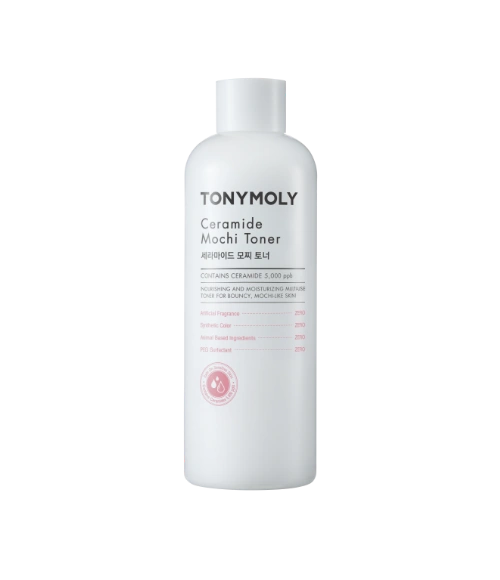
This is the one worth memorising. The ingredient list prints ceramide NP with a figure attached: 5,000 ppb.
Five thousand of anything sounds substantial. It is 5 ppm, which is 0.0005 percent by mass, and the entry sits third from last of thirty four.
Credit TONYMOLY for making that legible, and for one detail that matters more than it looks. The brand also writes 5,000ppb into its running marketing prose on the same page, which settles the only open question about the figure: the unit is ppb on purpose, not a mis-set ppm. A brand that prints the number twice has told you the truth about the dose twice.
The sentence wrapped around it is the part that does not hold. The page credits the ceramide with filling the skin with moisture. The moisture here is carried by dipropylene glycol, glycerin and propanediol, which take three of the first five positions, along with the emollient esters and hydrocarbons above the midpoint. Barrier lipid work also runs as a ratio of ceramides, cholesterol and free fatty acids, and neither of the other two classes appears at any of the thirty four positions.
The tell: read the unit before you read the digits.
Two units on one list
MEDI-PEEL RED LACTO COLLAGEN CLEAR FOAM CLEANSER 2.0
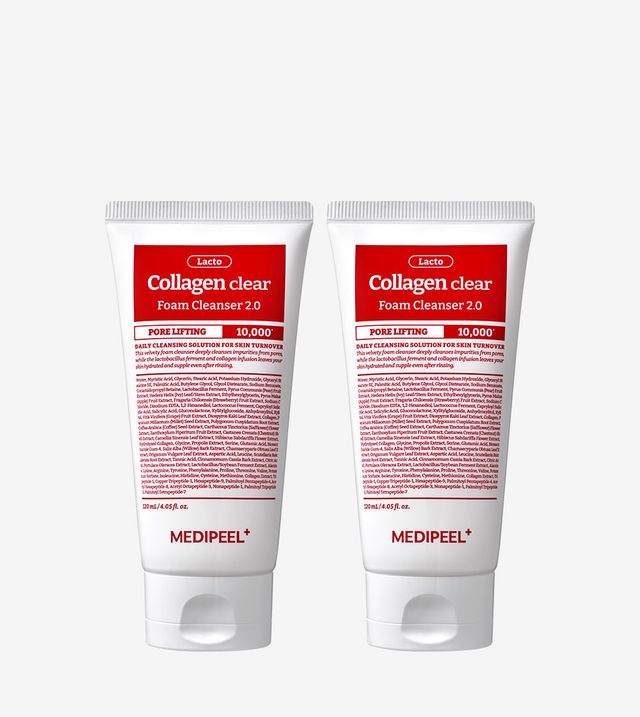
Collagen appears three times on this sixty-eight item list, and each time it carries a figure: 7,920 ppb, 2,500 ppb and 100 ppb. Together that is 10,520 ppb, which is 10.52 ppm, about 0.00105 percent of the product.
The disclosure is generous by category standards. It is also, by accident, self-defeating. The same list prints the lactobacillus ferment at 2,100 ppm, which is 0.21 percent, and on the page 2,100 and 7,920 sit near each other looking comparable. They are not. The lead ferment outweighs the largest collagen entry by roughly 265 to 1, and outweighs all three collagen entries combined by roughly 200 to 1. A product name that leads with collagen puts your attention on the smallest quantified thing in the formula.
Format matters here too. This is a foam cleanser, diluted with water, worked into a lather and rinsed within a minute, and the marketing attaches firmness and lifting to the collagen. Those are endpoints below the epidermis. What the formula genuinely does well is written in its first seven positions: fatty acids neutralised by potassium hydroxide, which is a potassium soap and among the most efficient sebum removers a face wash can be built on.
A trace in one place, a real design in another
RELAXLY Rose Spa Cleansing Oil
Three rose materials carry figures on this label: rosehip fruit oil at 10 ppm, damask rose flower water at 9.5 ppm and damask rose flower extract at 0.5 ppm. That is 0.001 percent, 0.00095 percent and 0.00005 percent. The page says the organic rose improves hydration and the barrier. At those levels the rose is a scent and a name, and the brand's own key ingredient block comes close to conceding it, crediting the rose complex with a spa feeling rather than with an effect on skin.
Now look further down the same list, at entries with no figures beside them. Ceramide NP, cholesterol and oleic acid sit together toward the back. That is a genuine barrier triad rather than a decorative ceramide dusting, and putting one inside a product you rinse off is an unusual thing to do. The three polyglyceryl esters at positions three, five and seven are a properly sequenced emulsifier design as well, laddering from oil wetting to phase inversion when water arrives.
So a single label carries both a trace that cannot support its sentence and a lipid set that is seriously composed. Ceramide and cholesterol belong to the same repair story, and the reason the second one being present matters is coming up next.
Small figures, read correctly
Everything above could leave you holding a rule that says small numbers are bad. That rule is wrong, and this label is why.
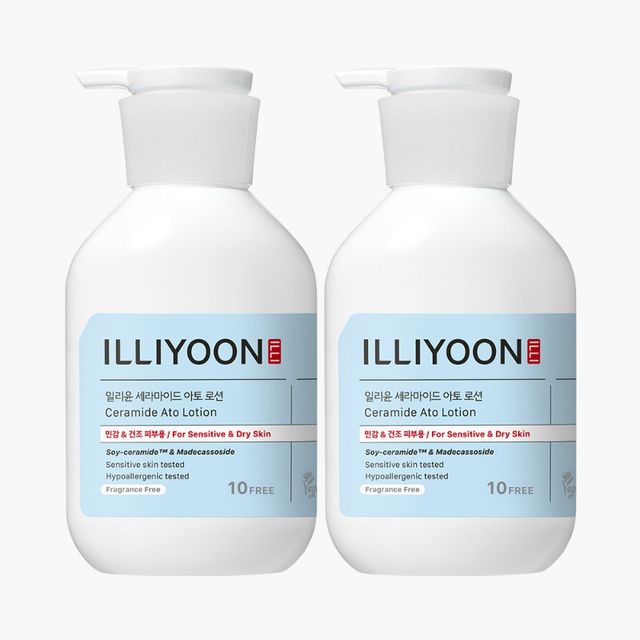
Illiyoon prints two ceramide-class figures on a forty-five item list: a pseudo-ceramide at 65.5ppm and ceramide NP at 4.04ppm. Those are 0.00655 percent and roughly 0.0004 percent. By arithmetic alone they are traces, in the same range as several of the figures above.
What differs is the company they keep. Cholesterol and phytosphingosine are both on the same list, so the lotion carries the physiological barrier-lipid set rather than one named lipid standing in for it. That is a deliberate, well-composed barrier design rather than label decoration. The list also carries no fragrance, no drying alcohol and no exfoliating acid, and the brand says outright that raw materials may be smelled as a result.
Illiyoon overstates elsewhere. Describing the ceramides as third generation is not a regulatory or scientific classification of anything, and nothing defines what it is meant to distinguish. But the concentrations are not the flaw. They are the reason you can tell.
The rule, then, is not that small is bad. It is that a number has to be read against what the ingredient needs and against what else on the label is there to work with it.
How to run this check yourself
About a minute per product, and every step happens on the label.
Find the brackets. Korean statutory lists permit a concentration in brackets after an ingredient name, and brands that use the option usually use it for the ingredient the product is named after. Scan for round brackets containing a number.
Read the unit before the digits. A four-figure ppb number is the shape most likely to read larger than it is, and it is the shape reached for when the honest ppm figure would be a single digit.
Note the position. Korean labelling requires descending order down to a threshold, below which ordering is free. Third from last of thirty four is information, whatever the marketing block says.
Compare figures on the same label rather than against nothing. This is the step most people skip and the one that pays. When one list prints 2,100 ppm for a ferment and 7,920 ppb for the collagen in the product's own name, the label has ranked the formula for you.
Then ask what the ingredient needs. Here the check stops being arithmetic. Ceramides do their job at low levels when cholesterol and a fatty acid are present with them. Vitamin C in a rinse-off does not do its job at a level written with five zeros after the decimal point. Same size of number, opposite conclusions.
The same habit applies to a whole ingredient category in what a printed PDRN figure actually says, and the other shapes a printed number takes are collected in five kinds of number we would not buy blind.
Common questions
Why would a brand print a number that undercuts its own marketing?
Because the two halves of the page are usually written by different people for different purposes. The ingredient statement is a regulatory document and the marketing block is not, and the regulatory half is the one that has to be right. That mismatch is what makes the check possible at all.
Does a trace ingredient do nothing?
Not always, and that is the distinction this article exists for. Some materials are active at parts per million and some are not, and the class of ingredient decides which. What a trace cannot do is carry the whole reason you were told to buy the product.
If a brand prints no figure at all, is that worse?
It is less checkable, which is not the same thing. A brand that discloses is handing you a way to disagree with it, and several of the labels above are only readable because their makers chose to print. The absence of a bracket means the question stays open, not that the answer is bad.
Which figures should change what I buy?
The ones attached to the ingredient the product is named after. If the name of the thing on the front is printed at a level five or six decimal places below a working dose, buy the product for what the rest of the formula does instead, and stop paying attention to the front.
If a bottle you own prints a concentration and you cannot tell whether it is a working dose or a trace, send us the ingredient list and we will place the number for you.
Products mentioned
Key: Citrus Tangerina Peel Extract, Citrus Grandis Peel Oil, Ascorbic Acid
6 claims, summarized
- Don't count on:
- less visible dark spots
See each claim
claims, checked
It contains green tangerine extract (tangerine extract) and vitamin C, so after washing, clear skin care as if you had done a vitamin pack is possible
overstatedThe refreshing green tangerine sherbet texture melts softly into the skin and cleanly washes away everything from makeup to blackheads and flakes
overstatedWith one-step cleansing power that needs no bothersome double cleansing, clean cleansing is possible by packing just one travel kit without other washing tools
overstatedThe steady seller Green Tangerine Vita C Toning Cleansing Balm
no supporting source foundMFDS-notified functional ingredient: helps with brightening
contradicted by sourcesEquipped with both product performance and portability
nothing specific to check
TONYMOLY
Ceramide Mochi Toner
It's made for better hydration.
Key: Ceramide, Panthenol, Centella Asiatica Extract
17 claims, summarized
- Only partly backed:
- better hydration
- Don't count on:
- firmer skin · better barrier support
- Tests passed:
- skin irritation
See each claim
claims, checked
Caution: a patch test is recommended for sensitive skin
backed by evidenceNot a functional product
backed by evidenceRecommended situations: when dryness is felt, when you want to keep the routine simple
plausible, not testedAs a wipe-off toner: dispense an appropriate amount onto a cotton pad, wipe gently along the grain of the skin, then pat lightly to absorb.
plausible, not testedIngredient points: ceramide, hyaluronic acid, panthenol, centella extract
partly backedDaily routine: the first step after washing (morning/evening)
partly backedFeel guide, recommendations by skin type: (oily/combination) a fresh wipe-off toner · (dry/inner dryness) a moist toner pack and layering
partly backedAs a moisturising pack: soak a cotton pad generously, place it on dry skin and remove after 10 minutes.
partly backedIt is a milky texture that balances oil and moisture. The ceramide ingredient does not sit on top of the skin but absorbs densely like mochi, leaving only a deep moisturised feel without stickiness.
partly backedUsing it as a 'toner pack' by soaking a cotton pad generously and laying it on dry areas for 5 to 10 minutes, or putting it in an empty bottle and spraying it frequently like a mist, helps create dense mochi skin.
partly backedIt is a viscous milky white texture, but the moment it touches the skin it spreads softly and absorbs quickly, raising the adherence of the next skincare step.
partly backedThe ceramide ingredient fills moisture and nourishment at the same time.
overstatedFragrance: a subtle citrus scent
overstatedYou can use it with confidence on sensitive and dry skin.
overstatedIt contains 5,000ppb of ceramide, which firmly cares for the skin barrier, protecting the skin from external irritation and blocking moisture evaporation.
overstated2 million units sold cumulatively! It is Tonymoly's flagship toner.
no supporting source foundIt is a product whose gentle feel was verified through a human application test.
no supporting source found
Key: Myristic Acid, Stearic Acid, Potassium Hydroxide
5 claims, summarized
- Don't count on:
- less visible pores · firmer skin
See each claim
claims, checked
99.4% cleansing power for impurities inside pores
overstatedExperience skin elasticity and lifting with Medipeel's Red Lacto Collagen Clear Foam Cleanser. Clean down to the pores with aesthetic know-how.
overstatedRed Lacto Collagen Clear Foam Cleanser 2.0
overstatedImpurities cleanly away with the technique of an aesthetic specialist. With the power of collagen and the softness of lacto, it delivers the skin's own natural health.
nothing specific to check[Olive Young No. 1 item] Red Lacto Collagen Wrapping Mask 70ml
nothing specific to check

RELAXLY
Rose Spa Cleansing Oil
It's made for better hydration.
Key: Helianthus Annuus (Sunflower) Seed Oil, Glycine Soja (Soybean) Oil, Polyglyceryl-4 Oleate
7 claims, summarized
- Only partly backed:
- better hydration
- Don't count on:
- better barrier support
- Tests passed:
- skin irritation
See each claim
claims, checked
A fresh rinse with no residue feeling through proprietary 3-stage emulsification.
partly backedMakeup Removal Rate 93.50%
partly backedTransepidermal Water Loss (TEWL) reduction, 11.95% decrease
partly backedImmediate Skin Hydration increase right after washing, 72.40% increase
partly backedPrimary Irritation Score on sensitive skin (Human Patch Test) 0.00 (Low Irritation)
partly backedPlant-derived polyglyceryl, ceramide and organic rose improve moisture and the barrier without skin irritation.
overstatedSunscreen Removal Rate 94.48%
overstated
Illiyoon
Ceramide Ato Lotion
It's made for better hydration and calmer skin.
Key: Cetyl-PG Hydroxyethyl Palmitamide, Ceramide, Cholesterol
14 claims, summarized
- Only partly backed:
- better hydration · calmer skin · better barrier support
- Free of:
- 10 listed ingredients
- Tests passed:
- dermatologist check · skin irritation
See each claim
claims, checked
Because no fragrance is blended in, the inherent smell of the ingredients may be noticeable.
backed by evidenceIt provides a melting texture that absorbs quickly without stickiness
plausible, not testedIt helps with skin barrier improvement, moisture supply, prevention of moisture loss and skin soothing, and
plausible, not testedit has received safety verification including a completed sensitive panel test and allergy test, confirmation of allergy after 3 weeks of cumulative application on 100 subjects, and passing the German Dermatest 24-hour patch test
partly backedWith a Fragrance Free formula that infants can also use, it has completed a sensitive panel test and an allergy test.
partly backedIt is fragrance free and, being free of 10 specified ingredients (10 FREE), can be used more gently.
partly backedIt passed the German Dermatest 24-hour patch test, a dermatological test, a sensitive panel test and an allergy test (3 weeks of cumulative application on 100 subjects), and
partly backedit received vegan certification from the Korea Vegan Certification Institute.
partly backedThird generation Ceramide Ato sensitive moisture soothing lotion
overstatedMoisture lasts 100 hours, and
overstatedon the basis of 10 stratum corneum tape strippings, it fills inner moisture down to 10 layers of the stratum corneum
no supporting source foundon the basis of moisture content measurement it moisturises 2.8 times faster, and
no supporting source foundwith numerically verified sensitive skin resilience, it helps recover temporary redness caused by external irritation and the damaged skin barrier
no supporting source foundIn customer satisfaction after just one use, it was confirmed at 96% for sufficient moisture without reapplying, 93% for feeling gentle because it is fragrance free, 90% for relieving inner tightness, 90% for immediate moistness and 93% for recommending it for delicate skin
no supporting source found