Bakuchiol or retinol: the gentle one is the one you cannot check
Retinoid labels print a level 16 times out of 25. Bakuchiol labels print one once out of 15. That asymmetry decides which of the two you can shop for.
Bakuchiol is sold as the gentle plant alternative to retinol. The comparison people want is which one works better, and a label cannot answer that.
Here is what a label can answer, and it turns out to be the more useful question.
We read every Korean product in our set that carries a retinoid or bakuchiol. Retinoids appear on 25 labels and 16 of them print a concentration. Bakuchiol appears on 15 labels and exactly one prints a concentration.
So one of these two ingredients is something you can comparison shop. The other is a word on a box. That asymmetry matters more than any claim about gentleness, because a gentle ingredient at an unknown level is not a known quantity in either direction.
What is the actual difference between them?
Retinoids are vitamin A derivatives and they work through nuclear receptors in skin cells. Korean labels carry them in four forms, and the form changes the potency.
- Retinoic acid is the prescription form and is not in cosmetics.
- Retinaldehyde, printed 레틴알, converts to retinoic acid in fewer steps than retinol does.
- Retinol takes an extra conversion step.
- Retinyl palmitate is an ester and the weakest of the four.
Bakuchiol is not a vitamin A derivative at all. It is a plant compound from Psoralea corylifolia, structurally unrelated to retinoids, and the interest in it comes from published work reporting retinol like effects with less irritation.
We are not going to adjudicate that literature from ingredient lists, and you should be suspicious of anyone who does. What we can tell you is what the bottles say.
One thing worth flagging before the products. The one Korean label in our set that discloses a bakuchiol level puts it at 0.25 percent, and the published work on bakuchiol most often runs at roughly twice that level or higher. That is a real gap between the shelf and the research, and it is visible only because one brand printed the number.
Ongredients Bakuglow Retinal Booster Shot 0.2%
The clearest illustration of the whole problem, because both ingredients are in this bottle and only one of them has a number.
Retinaldehyde is twelfth of 61 entries, printed at 0.2 percent. Bakuchiol is thirty fifth, with no figure at all.
Now read the name. Bakuglow leads with the bakuchiol. The 0.2 percent in the same name belongs to the retinal, and the product information says so plainly, so nothing here is deceptive. But a shopper scanning a shelf sees a bakuchiol product with a percentage attached, and the percentage is not the bakuchiol's.
The rest of the formula is thoughtfully built around retinoid tolerance rather than against it. Niacinamide is seventh, ceramide NP is at 38, and there is cholesterol and a rapeseed sterol further down, which is the lipid set that retinoid dryness actually needs. Adenosine sits at 30 in the usual spot for the notified wrinkle active.
At 0.2 percent retinal this is a strong product, not a beginner one. Retinaldehyde converts in fewer steps than retinol, so treat this as the high end. If you are pregnant or breastfeeding, skip it, and that is because of the retinal rather than the bakuchiol.
Disclosed: retinal at 0.2 percent. Bakuchiol, no figure Fragrance-free: yes
COSRX The Blue Copper Peptide Bakuchiol Serum, Glow & Plumping
The only Korean label in everything we read that prints a bakuchiol level.
Bakuchiol is fourteenth of 39, at 0.25 percent. That is the entire published Korean disclosure for this ingredient as far as our reading goes, which is a strange thing to be able to write about an ingredient with this much shelf presence.
It sits next to copper tripeptide-1 at 0.5 percent in position 11, which is the highest disclosed peptide level we have found anywhere and the reason the serum is blue. We went through that label in detail in peptides on a Korean label.
For the comparison in this piece, the useful part is that 0.25 percent is a number you can actually take somewhere. You can hold it against the research, where the concentrations studied are generally higher. You can hold it against the next bakuchiol product you pick up, and discover that the next one gives you nothing to hold.
Two notes. Ethanol is at 16 of 39, so this is not for anyone avoiding alcohol. And niacinamide is fifth, high enough that part of this bottle's work is niacinamide work.
There is no retinoid here, so no pregnancy caution attaches to this one on the retinoid axis.
Disclosed: bakuchiol at 0.25 percent Fragrance-free: yes
DR.DIFFERENT Retinal 1500 Signature Cream
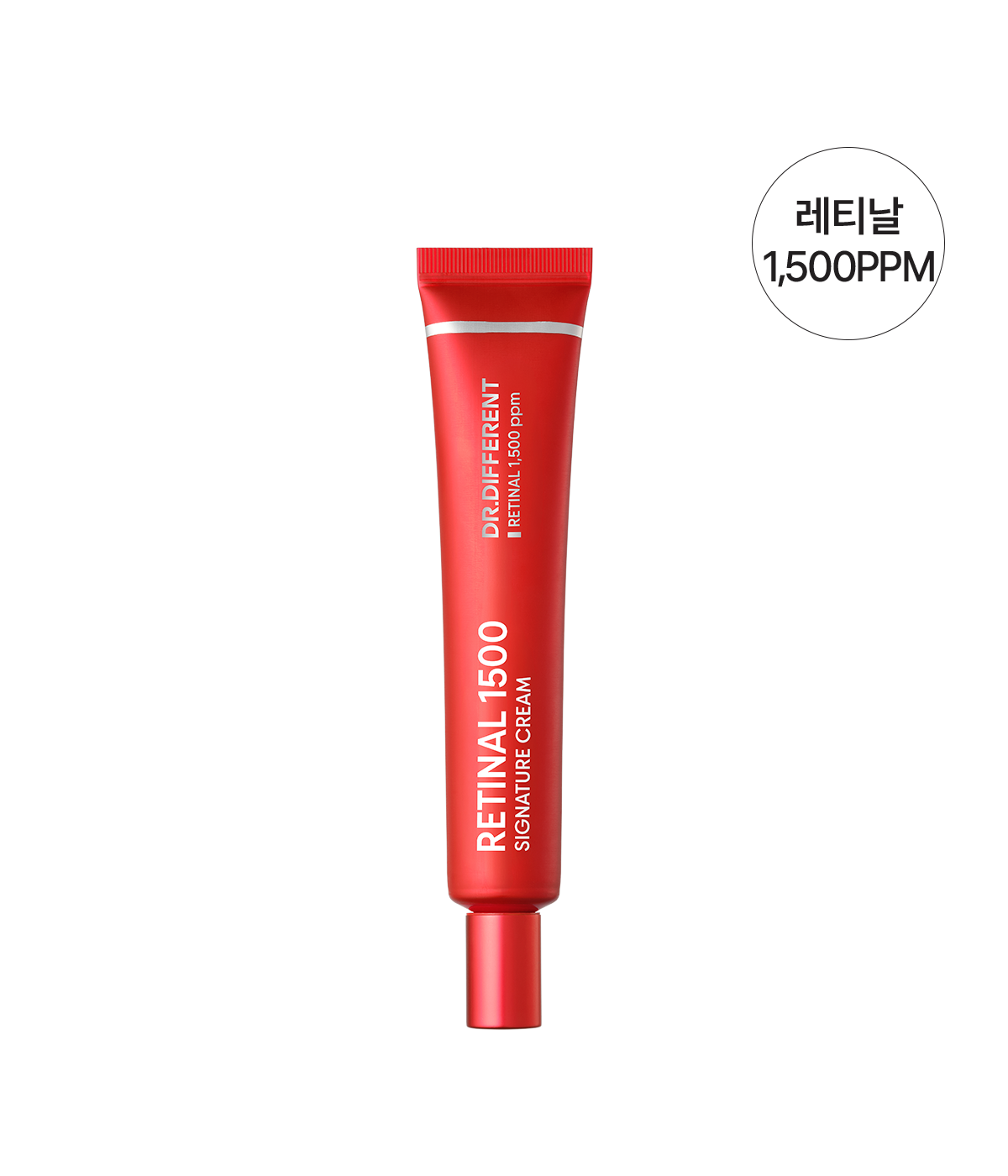
What honest dose labelling looks like when a brand commits to it, and the clearest argument for why retinoids are easier to shop for.
Retinaldehyde is sixteenth of 24, printed at 0.15 percent. The number in the product name is the level in parts per million: 1500 parts per million is 0.15 percent.
That naming holds across the line. The 500 version discloses 0.05 percent, the 1000 version discloses 0.1 percent, the 1500 version discloses 0.15 percent. Three products, three printed figures, and the product names are the doses rather than decoration. You can pick your strength and step up deliberately, which is exactly the thing bakuchiol shopping does not let you do.
Two more vitamin A forms sit on the same list without figures: retinol at 18 and retinyl palmitate at 23. So the total retinoid exposure is a little more than the printed 0.15 percent, by an amount nobody states. Worth knowing if you are stacking.
The base is built for the job, with squalane fourth, cholesterol eighth and a ceramide in the middle. Oleic acid is on the list, which is a consideration if you are prone to fungal acne or congestion.
This is the strongest product in this article. Do not start here, do not stack acids or vitamin C in the same session, and skip it entirely if you are pregnant or breastfeeding.
Disclosed: retinal at 0.15 percent. Retinol and retinyl palmitate, no figures Fragrance-free: yes
PO:DL Chestnut Retinal Pore Reset Solution Capsule Cream
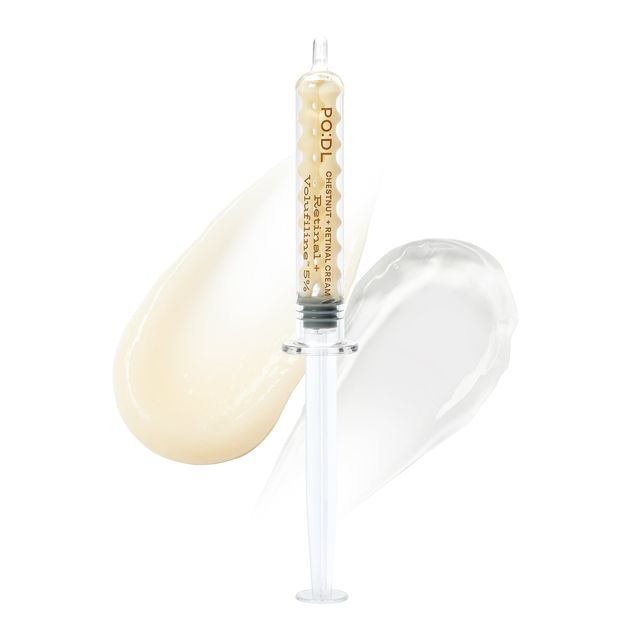
The reason we keep arguing for disclosure, because disclosure cuts both ways and this is the direction people forget.
This is a two phase product, a gel and a capsule, so the statement is two lists run together. Retinaldehyde is the very last entry of the combined statement, printed at 0.01 parts per billion.
Sit with that unit. The Ongredients product above carries retinal at 0.2 percent, which is 2,000,000 parts per billion. This one discloses 0.01. That is a two hundred million fold difference between two products that both say retinal on the front.
Retinol and retinyl palmitate are also present, both without figures, so the true vitamin A load is not zero and is not stated. But the one retinoid figure the brand chose to print is this one.
We want to be exact about the tone here, because the brand did the right thing. Printing 0.01 parts per billion is a disclosure almost nobody would make, and it is the only reason you can tell this product apart from a genuine retinal cream. A brand that printed nothing would have looked stronger.
What is likely doing the work is elsewhere: niacinamide appears early in both phases, there is a chestnut shell extract at 125 parts per million in the gel, and adenosine carries the wrinkle registration. Judge it as a niacinamide cream with a nice capsule texture.
Note that pregnancy caution still applies, because retinol and retinyl palmitate are on the list at undisclosed levels.
Disclosed: retinal at 0.01 parts per billion Fragrance-free: yes
So which should you buy?
If you want a retinoid, you can shop on the number. Pick the form, pick the level, start low and go slowly. Four of the products above tell you where they sit, and one brand gives you a whole ladder to climb. That is a real advantage and it belongs to retinoids rather than to bakuchiol.
If you want bakuchiol, understand what you are buying. In fourteen of the fifteen bakuchiol labels we read, there is no way to tell whether the ingredient is a formulation choice or a name on a box. The one that does disclose sits at 0.25 percent, below where most of the published work runs.
Gentle is not a property of an ingredient, it is a property of a dose. Bakuchiol at an undisclosed level could be gentler than a retinoid because it is a milder molecule, or because there is barely any of it, and the label does not distinguish those two. That is the honest summary and it is not a satisfying one.
Two practical notes that do not depend on any of this. Retinoids of all four kinds are the reason for a pregnancy caution, and bakuchiol is not a vitamin A derivative so it does not carry that particular flag. And if you are starting any retinoid, the introduction matters more than the strength, which we wrote up in starting retinol.
Common questions
Is bakuchiol as effective as retinol?
We cannot answer that from labels and we are not going to pretend otherwise. What the labels do establish is that you can compare one retinoid product to another on printed levels, and you almost never can with bakuchiol, so an effectiveness comparison between two specific products on a shelf is usually not available to you.
Can I use bakuchiol while pregnant?
Bakuchiol is not a retinoid, so it does not carry the retinoid pregnancy caution. That is not the same as a clearance, and several bakuchiol products also carry a retinoid, including one in this article. Read the whole list and ask your own doctor rather than the box.
Does retinal work better than retinol?
Retinaldehyde converts to the active form in fewer steps, which is why products using it are often labelled at lower percentages than retinol products. Comparing a retinal percentage against a retinol percentage directly is not meaningful. Compare within a form.
What does a number like 1500 or 500 on a retinal product mean?
In the line above, it is parts per million, so 1500 is 0.15 percent and 500 is 0.05 percent, and the brand's printed figures confirm it. Do not assume this holds for every brand. Check the figure in the ingredient list rather than trusting the name.
Can I use bakuchiol and a retinoid together?
Several products already combine them, including the first one in this article, so the combination is not treated as a conflict. The usual retinoid cautions still apply: one strong actives step per session, sunscreen the next morning, and do not stack acids on the same night.
If you have a bakuchiol product and cannot find a level on it, send us the listing and we will look for one.
Products mentioned
Ongredients
Bakuglow Retinal Booster Shot 0.2%
We checked 3 lines this product advertises against the ingredient list and public documents. None of them hold up on their own. They are partly right at best.
2partly backed1no evidence
See the label check (3 lines)
Claims translated from Korean, originals preserved.
- Retinal Booster Shot 0.2 percent
Korean original
레티날 부스터 샷 0.2퍼센트
- Baku Glow
Korean original
바쿠글로우
- All skin
Korean original
모든 피부
COSRX
The Blue Copper Peptide Bakuchiol Serum, Glow & Plumping
We checked 2 lines this product advertises against the ingredient list and public documents. One of them holds up. The rest are only partly right or have nothing behind them.
1backed1likely
See the label check (2 lines)
Claims translated from Korean, originals preserved.
- Blue (Copper Tripeptide)
Korean original
블루 (카퍼트라이펩타이드)
- Gyeolgwang (Glow & Plumping)
Korean original
결광 (Glow & Plumping)
DR.DIFFERENT
Retinal 1500 Signature Cream
We checked 2 lines this product advertises against the ingredient list and public documents. None of them hold up on their own. They are partly right at best.
1likely1says nothing
See the label check (2 lines)
Claims translated from Korean, originals preserved.
- A high-concentration solution that powerfully cares for deep wrinkles and elasticity with retinal 0.15% stabilized by liposome technology
Korean original
리포솜 기술로 안정화한 레티날 0.15%로 깊은 주름과 탄력을 강력하게 케어하는 고함량 솔루션
- High-Strength Retinal
Korean original
고강도레티날
PO:DL
Chestnut Retinal Pore Reset Solution Capsule Cream
We checked 3 lines this product advertises against the ingredient list and public documents. None of them hold up on their own. They are partly right at best.
1overstated1no evidence1says nothing
See the label check (3 lines)
Claims translated from Korean, originals preserved.
- Night Retinal Pore Reset Solution Capsule Cream
Korean original
밤 레티날 모공 리셋 솔루션 캡슐 크림
- Podeul, a skincare brand focused on pores and aging, a real pore solution designed with data from 1 million people
Korean original
모공과 노화에 집중한 스킨케어 브랜드 포들, 100만명의 데이터로 설계한 진짜 모공 솔루션
- [Wendy PICK]
Korean original
[웬디PICK]