Peptides on a Korean label, and the billion fold range between them
Five Korean products that print every peptide level they hold. The highest is half a percent and the lowest is two thousandths of a part per billion.
Peptide is not an ingredient. It is a shape of molecule, a short chain of amino acids, and the label entries built on that shape number in the hundreds.
Which makes peptide on the front of a box about as informative as extract. It names a category, not a material and not an amount.
The good news is that this is one of the categories where Korean brands print numbers. The five products below disclose every peptide level they hold. Read together, the highest figure is 0.5 percent and the lowest is two thousandths of a part per billion. That is a range of roughly two and a half billion to one, across products that are all sold on peptides.
What does a peptide name actually tell you?
Three things, and none of them is a dose.
The length. Di is two amino acids, tri is three, penta is five, hexa is six. Tripeptide-1 and hexapeptide-9 are different molecules, and the number after the dash is a registry index rather than a strength.
The attachment. Palmitoyl in front of a peptide name means a fatty acid chain has been bonded to it, which is a formulation decision about moving a water loving molecule through an oil loving barrier. Acetyl is a different modification for a related reason.
The source convention. The sh- prefix, as in sh-oligopeptide-1, marks a peptide made by a synthesised host organism rather than extracted. It is a manufacturing descriptor.
None of these tells you how much is in the bottle, and peptides are one of the classes where the answer is most often very little. So the figure, when a brand prints one, is the whole game.
One more thing to set up front, because it decides how to read the rest. Korean labelling lets entries below one percent be listed in any order. Every peptide figure in this article is below one percent. Position on the list therefore tells you almost nothing here, and two of the products below prove it in opposite directions.
COSRX The Blue Copper Peptide Bakuchiol Serum, Glow & Plumping
The highest disclosed peptide level in everything we have read, and the widest spread on any single label.
Copper tripeptide-1 is printed at 0.5 percent, at position 11 of 39. That is 5,000 parts per million, and it is the figure the product's blue colour and its name both rest on. Copper tripeptide solutions are blue, so the colour here is the ingredient rather than a dye, which is a rare case of packaging telling the truth by accident.
Then the same label keeps printing. A dipeptide at 0.5 parts per million, acetyl hexapeptide-1 at 0.1, acetyl heptapeptide-4 at 0.0457, acetyl hexapeptide-8 at 0.004, and acetyl octapeptide-3 at 0.0003 parts per million in the final position.
Line those up. The top and bottom peptide figures on this one label differ by a factor of about sixteen million. Six peptides, six numbers, one product, and the brand printed all of it.
This is the most useful label in the piece for exactly that reason. It shows that a roster and a dose can live on the same ingredient list, and that the only way to tell them apart is the number. Without the figures, acetyl octapeptide-3 and copper tripeptide-1 would look like equal partners in the formula.
Bakuchiol is also printed here, at 0.25 percent, which is the only disclosed bakuchiol level we have found anywhere.
Two notes before buying. Ethanol sits at 16 of 39, so this is not the serum for someone avoiding alcohol entirely. And niacinamide is fifth, which is high, so part of what this bottle does is niacinamide work rather than peptide work.
Peptides disclosed: 6 of 6, from 0.5 percent to 0.0003 parts per million Fragrance-free: yes
COSRX The 6 Peptide Skin Booster Serum
The clearest case of peptides placed high on a list, and the one that breaks the intuition about position.
Six peptides, six printed figures, occupying positions 7 through 12 of 44. Acetyl hexapeptide-8 at 5 parts per million, copper tripeptide-1 at 5 parts per million, sh-polypeptide-121 at 1.98, a dipeptide at 0.3, oligopeptide-68 at 0.095, palmitoyl tripeptide-8 at 0.02.
The product name says six peptides and the label delivers exactly six with exactly six numbers. That is a claim that survives being checked, which is rarer than it should be.
Now hold it against the serum above. Copper tripeptide-1 appears in both. Here it is at 5 parts per million in position 8. There it is at 5,000 parts per million in position 11. The lower concentration sits in the earlier position, because both are under one percent and the ordering rule stops ranking there.
That is the whole argument for reading figures instead of positions, in one comparison between two products from the same brand.
The rest is sensible: niacinamide sixth, allantoin, sodium hyaluronate, and a long free amino acid block acting as a natural moisturising factor set. Adenosine sits at 37 in the usual place for the notified wrinkle active. One list note, t-butyl alcohol appears at 42 of 44, which is a denaturant placement rather than a solvent load.
Peptides disclosed: 6 of 6, from 5 to 0.02 parts per million Fragrance-free: yes
OGANACELL Bio Actiome Cream
The same lesson from the other direction: a substantial figure sitting near the bottom of its own list.
Copper tripeptide-1 is printed at 110 parts per million, with hexapeptide-61 dimer at 1 part per million, at positions 46 and 47 of 51.
110 parts per million is 0.011 percent, comfortably under the one percent line, so a late position is exactly where it belongs. It is twenty two times the copper tripeptide level in the serum above, which carries it at position 8.
So the reader ranking by position would put this cream last of the three so far. The reader reading figures would put it second. The second reader is right.
The rest of the cream is a conventional and competent emollient build: shea butter fourth, a fatty alcohol and silicone structure, niacinamide eighth, and a centella group with ceramide NP through the middle. Adenosine sits at 22.
One thing to know: there is a fragrance ingredient at the very end of the list.
Peptides disclosed: 2 of 2, at 110 and 1 parts per million Fragrance-free: no
Wellage Hyper Peptide Skin Booster Toner
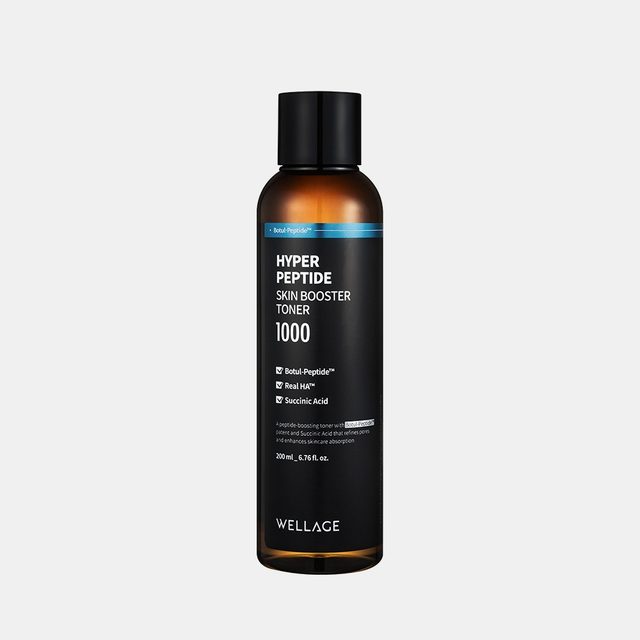
The middle of the range, on a seventeen entry list short enough to read in full.
Four peptides close the list and all four carry figures: tripeptide-1 at 750 parts per billion, an oligopeptide at 150 parts per billion, acetyl hexapeptide-8 at 100, palmitoyl pentapeptide-4 at 100.
Parts per billion is the unit to slow down on. 750 parts per billion is 0.75 parts per million, so the top peptide here is under a sixth of the top peptide in the six peptide serum, and about one six thousandth of the copper tripeptide in the blue one.
The naming deserves a note. One peptide here is printed with a name referencing a bacterial toxin, and the product sits in language borrowed from clinic procedures. The pharmacology does not carry over. An injected treatment places material in a layer a toner does not reach, and the quantities are not comparable in either direction.
We covered this label's other half, the wrinkle registration it holds and the ingredient behind it, in what adenosine actually does. Short version: adenosine is ninth here with no figure, and the four peptides that are not carrying the registration all got numbers.
The list has no lipid of any kind, so put a moisturizer over it.
Peptides disclosed: 4 of 4, from 750 to 100 parts per billion Fragrance-free: yes
MEDICUBE Zero Pore One-Day Peptide Serum
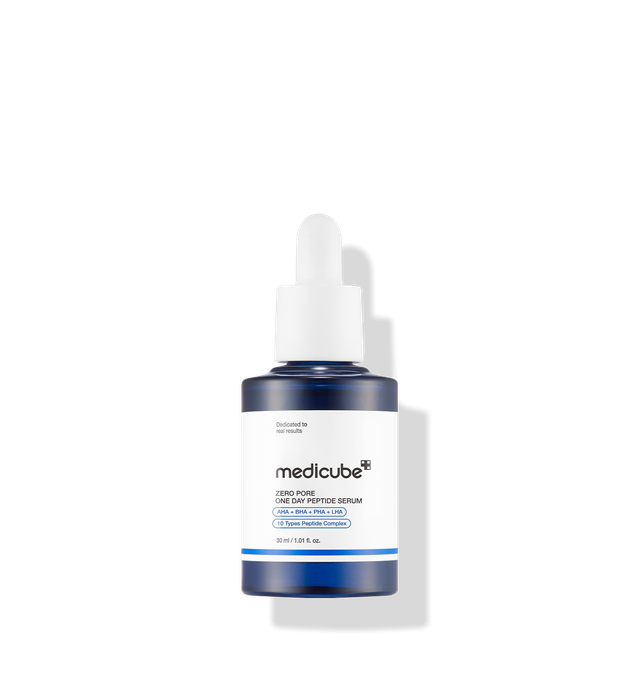
The floor of the range, and ten disclosures rather than four.
Every peptide on this label carries a figure: 8 parts per billion at the top, then 1.1, then 1, then 0.5, then 0.2, then copper tripeptide-1 at 0.05, and then four more at 0.002 parts per billion each.
Two thousandths of a part per billion is the smallest number in this article by three orders of magnitude. The peptides are the product name.
We keep saying this and it stays true: the disclosure is the good part. A brand that wanted this hidden would have listed ten peptides with no figures, which is what most products do, and nobody could then have told this serum apart from the blue one at half a percent.
What is actually working in this bottle sits underneath the roster. Glycolic acid, salicylic acid and a lipophilic salicylic acid derivative make a genuine acid combination, with niacinamide and adenosine alongside. Buy it as an exfoliating serum and it is a good one. If you are pregnant, the salicylic acid is a reason to skip it, and the brand's own sun sensitivity warning is worth following.
Peptides disclosed: 10 of 10, from 8 to 0.002 parts per billion Fragrance-free: yes
How to read a peptide product
Find the figure. With no figure anywhere on the label, you are buying a name, and there is no way to tell from the outside whether that name sits on half a percent or on two thousandths of a part per billion. Both exist. Both look identical on a front of box.
Convert to one unit before comparing. Brands mix percent, parts per million and parts per billion freely, sometimes on the same label. One percent is 10,000 parts per million is 10,000,000 parts per billion. A figure quoted in parts per billion is a thousand times smaller than the same digits in parts per million.
Ignore the position. Everything here is below one percent, which is where the Korean ordering rule stops ranking. The two serums above carry the same peptide at levels a thousandfold apart, and the weaker one sits higher on its list.
Count the names against the numbers. Six names and six figures is a claim that closes. Ten names and no figures is a roster.
And read what else is on the list. In four of the five products above, the ingredient most likely to change something about your skin is not a peptide. It is niacinamide, or an acid, or a well built emollient base. That is not a scandal, it is what the label says. We made the same point about a different acronym in what PDRN actually is, and about disclosure generally in the ppm the brand printed itself.
Common questions
Are copper peptides better than other peptides?
Copper tripeptide-1 is the peptide with the longest history in cosmetic use and it appears in four of the five products here. What the labels show is that its disclosed level varies by a factor of about a hundred million between them, from 0.5 percent down to 0.05 parts per billion. Which peptide matters far less than how much.
Does parts per billion mean it does nothing?
It means the amount is very small, and small is not zero. The honest position is that a level several orders of magnitude below any published use figure for the same molecule is a label entry, and a brand that prints it is telling you so.
Why do brands use so many peptides at once?
Because ten names read as more than one, and because adding a tenth peptide at two thousandths of a part per billion costs almost nothing. The roster is a marketing structure. When the figures are printed you can see that directly, and the blue serum above shows a roster and a real inclusion sitting on the same label.
Should peptides go before or after other actives?
As a leave-on step among leave-on steps, ordinary order applies: thinner before thicker. None of these carries an interaction risk with common actives. The toner has no lipid at all, so something needs to go over it regardless.
Is a higher position on the list better?
Not below one percent, and every peptide figure here is below one percent. The cream with 110 parts per million carries it at position 46, while a serum carrying five parts per million of the same peptide has it at position 8. The figure beats the position every time.
If you have a peptide product and you cannot work out which of its names carry numbers, send us the listing and we will line them up.
Products mentioned
COSRX
The Blue Copper Peptide Bakuchiol Serum, Glow & Plumping
We checked 2 lines this product advertises against the ingredient list and public documents. One of them holds up. The rest are only partly right or have nothing behind them.
1backed1likely
See the label check (2 lines)
Claims translated from Korean, originals preserved.
- Blue (Copper Tripeptide)
Korean original
블루 (카퍼트라이펩타이드)
- Gyeolgwang (Glow & Plumping)
Korean original
결광 (Glow & Plumping)
COSRX
The 6 Peptide Skin Booster Serum
We checked 2 lines this product advertises against the ingredient list and public documents. One of them holds up. The rest are only partly right or have nothing behind them.
1backed1likely
See the label check (2 lines)
Claims translated from Korean, originals preserved.
- The 6 Peptide
Korean original
더 6 펩타이드
- Functional cosmetic status: wrinkle improvement / whitening functional product
Korean original
기능성 화장품 여부: 주름개선 / 미백 기능성 제품
OGANACELL
Bio Actiome Cream
We checked 3 lines this product advertises against the ingredient list and public documents. None of them hold up on their own. They are partly right at best.
1likely1overstated1says nothing
See the label check (3 lines)
Claims translated from Korean, originals preserved.
- Copper Tripeptide-1 (110ppm)
Korean original
카퍼트라이펩타이드-1(110ppm)
- Hexapeptide-61 dimer (1ppm)
Korean original
헥사펩타이드-61다이머(1ppm)
- Organacell Bio Actiom Cream 50ml
Korean original
오가나셀 바이오 액티옴 크림 50ml
Wellage
Hyper Peptide Skin Booster Toner
We checked 7 lines this product advertises against the ingredient list and public documents. One of them holds up. The rest are only partly right or have nothing behind them.
1backed1likely1partly backed1overstated2no evidence1says nothing
See the label check (7 lines)
Claims translated from Korean, originals preserved.
- Wrinkle-improving functional cosmetic
Korean original
주름개선 기능성 화장품
- All skin types
Korean original
모든피부타입
- Toner that smoothly adheres to dense pore texture
Korean original
매끈하게 밀착되는 촘촘 모공결 토너
- Proprietary patent Botul-Peptide™
Korean original
독자 특허 Botul-Peptide™
- Inner pore elasticity
Korean original
모공속탄력
- Pore scaling
Korean original
모공스케일링
- Pore prescription
Korean original
모공처방
MEDICUBE
Zero Pore One-Day Peptide Serum
We checked 2 lines this product advertises against the ingredient list and public documents. None of them hold up on their own. They are partly right at best.
1partly backed1no evidence
See the label check (2 lines)
Claims translated from Korean, originals preserved.
- A pore serum that adds pore elasticity and brightening of the pore area to pore shrinking
Korean original
모공 축소에 모공 탄력, 모공 부위 미백까지 더한 모공 세럼
- [BEST] From the additional product description of the 2-week pore tightening care set: 'improve pore elasticity with the two Zero Pore products'
Korean original
[BEST] 2주 모공 타이트닝 관리 세트 상품추가설명 중 '제로 모공 2종으로 모공 탄력 개선'