Round Lab
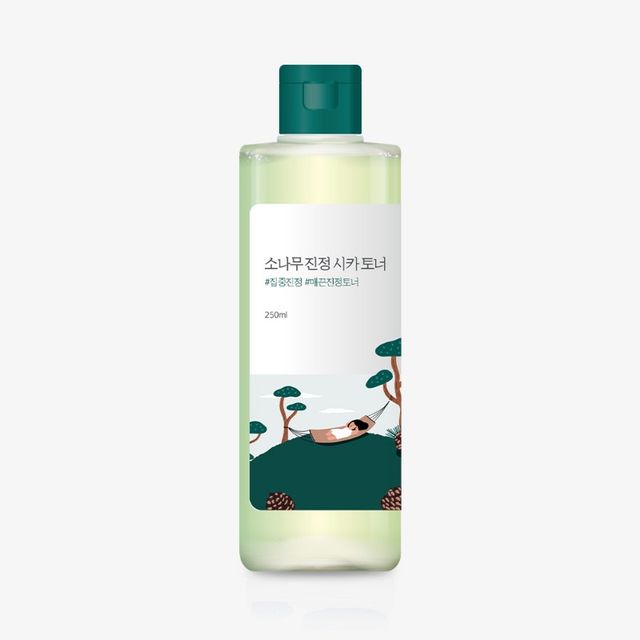
Round Lab Pine Calming Cica Toner
Ingredient analysis and how the ad lines read
Read on 2026-09-06
What is this product?
Round Lab's Pine Calming Cica Toner prints its amounts on the label, and those amounts are the reason to buy it: pine leaf extract is declared at 400,196ppm, which is 40.02 percent of the formula, centella extract at 10,699ppm and four purified centella markers at 0.4090ppm each, so the plants in the name are genuinely most of the product rather than a garnish. It suits reactive, dehydrated skin, with no fragrance, dye, essential oil or alcohol among its 24 ingredients and three forms of hyaluronic acid at 8th, 9th and 10th. Two things to weigh: Round Lab publishes no test of any kind behind it and no pH, and despite the calming framing it carries two mild acids, so skip it if you are pregnant.
What makes it different?
Seven printed concentrations on one label is the differentiator, and reading them across the shelf is what makes it useful: against another cica toner declaring its centella at 2.1ppm, this one declares 10,699ppm. It is also structurally bare in a good way, with no gum, no film former, no silicone and no oil anywhere on the list, which is rare even among toners. The gaps are on the evidence side rather than the formula side: no brand-run trial, test type, participant count or institution exists for it, the one line of marketing copy attached to it belongs to Kurly rather than to Round Lab, and the brand publishes no pH for a formula containing gluconolactone and capryloyl salicylic acid.
What is in it?
The full ingredient list as the brand publishes it, in the printed order. Each name links to what we know about that ingredient.
This brand publishes its ingredient list in Korean only. Names below are the matching INCI names from the Korean Cosmetic Association ingredient dictionary.
Key ingredient
- Water
- Pinus Densiflora Leaf Extract
- Propanediol
- Glycerin
- Centella Asiatica Extract
- 1,2-Hexanediol
- Butylene Glycol
- Hyaluronic Acid
- Hydrolyzed Hyaluronic Acid
- Sodium Hyaluronate
- Glycoproteins
- Ethylhexylglycerin
- Melia Azadirachta Leaf Extract
- Melia Azadirachta Flower Extract
- Asiaticoside
- Asiatic Acid
- Madecassoside
- Madecassic Acid
- Gluconolactone
- Capryloyl Salicylic Acid
- Sodium Citrate
- Hydroxyacetophenone
- Disodium EDTA
- Citric Acid
Ingredients with no mark are ones we found nothing notable about, and when marks overlap on one ingredient we show the caution first.
We could not place these in the list above: 카프릴로일살리실릭애씨드
Did the ad claims hold up?
We checked 6 lines this product advertises against the ingredient list and public documents. 4 of them hold up. The rest are only partly right or have nothing behind them.
Claims translated from Korean, originals preserved.
backed by evidence4
- Pine leaf extract (400,196ppm)
Korean original
소나무잎추출물(400,196ppm)
- Centella asiatica extract (10,699ppm)
Korean original
병풀추출물(10,699ppm)
- Glycoprotein (8.1800ppm)
Korean original
글라이코프로테인(8.1800ppm)
- Whether functional cosmetic review (or report) is required: not applicable
Korean original
기능성 화장품 심사(또는 보고) 필 여부: 해당없음
likely, not proven1
- A soothing toner that mildly tidies the grain of the skin
Korean original
순하게 피부결을 정돈하는 진정 토너
overstated ad line1
- Product main specification: for all skin types
Korean original
제품 주요 사양: 모든 피부용
Each line is quoted as the brand published it, and each one was read on its own against the ingredient list and the documents the brand publishes.
What else is worth seeing?
Products we read alongside this one.
Which articles cover it?
Articles on this site that write about this product.