Glutathione and tranexamic acid: the brightener on the box is rarely the big number
Tranexamic acid gets a printed figure on 11 Korean labels, glutathione on 17. Arbutin, the one the regulator actually notified, gets one on none.
There is a pattern in Korean brightening products, and once you have seen it you cannot stop seeing it.
The ingredient in the product name is almost never the one with the biggest printed number.
We read the Korean labels in our set carrying the three brighteners people ask about. Glutathione appears on 174 and 17 print a level. Tranexamic acid appears on 63 and 11 print a level. And arbutin, which is one of the ingredients Korea actually notified for whitening, appears on 38 labels and not one of them prints a level.
That last line should feel familiar if you read our piece on adenosine, where the notified wrinkle active turned out to be the one ingredient nobody discloses. It is the same pattern on the pigment axis: brands print the marketing ingredient and leave the regulated one blank.
What do these three actually do?
They act at different points of the same process, which is why products stack them.
Niacinamide interferes with the transfer of finished pigment into surface skin cells. It is a notified whitening active in Korea, conventionally in a 2 to 5 percent band, and it is the one brighteners are most often built around. We wrote it up in niacinamide basics.
Tranexamic acid works further upstream, interfering with the signalling route keratinocytes use to tell pigment cells to get going. It is not a notified active in the Korean scheme, which makes it interesting that it is the one most often printed.
Glutathione is an antioxidant tripeptide, and it is the one with the widest gap between reputation and label. It is also chemically awkward: it converts to its disulfide form on exposure to air and light, which is ordinary chemistry rather than a knock against any product.
Arbutin acts on the enzyme that makes pigment. It is notified. And it is invisible as a number.
We are not going to tell you these work from an ingredient list. What the labels can tell you is how much is in the bottle, and in this category that turns out to be the more surprising information.
numbuzin No.5 Glutathione C Mark Ampoule
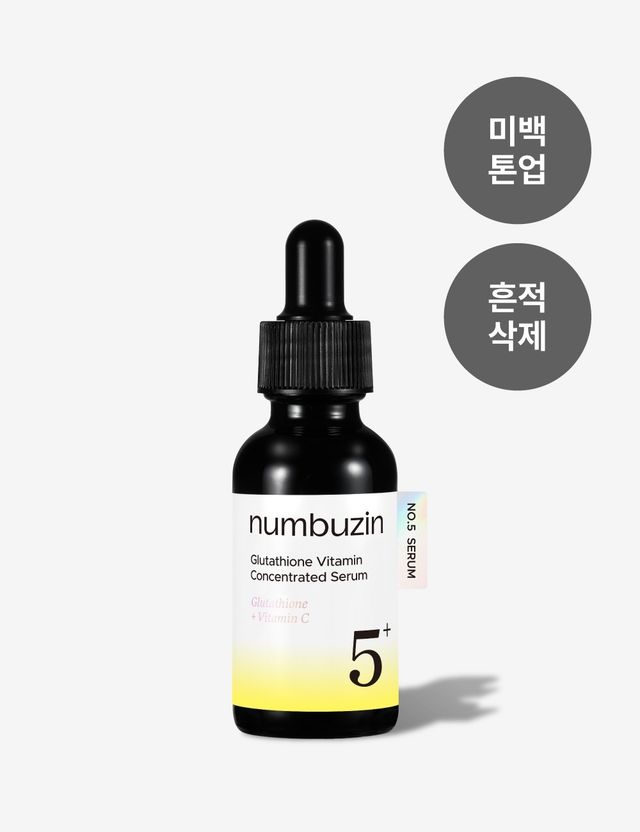
The single best label we found for this argument, because it prints seven figures and the pattern is right there in the order.
Niacinamide is third of 47 entries at 50,000 parts per million, which is 5 percent. Panthenol is also at 5 percent. Tranexamic acid is fifth at 40,000 parts per million, which is 4 percent. An ethyl ascorbic acid is at 2,000 parts per million.
Now find the glutathione. It is at position 32, at 100 parts per million.
The product is called Glutathione C. The glutathione is present at one four hundredth of the tranexamic acid sitting seven places above it, and the ascorbic acid and ascorbyl glucoside further down are printed at 1 part per billion each.
And the two ingredients with no number at all? Alpha-arbutin at 14 and adenosine at 29. Alpha-arbutin is a close cousin of notified arbutin rather than a notified active itself, and adenosine is the notified wrinkle active. Both are blank, on a label that was otherwise happy to print seven figures including two at parts per billion.
We want to be fair: this is a genuinely well built tone product and the disclosure is exemplary. Niacinamide at 5 percent and tranexamic acid at 4 percent are working levels, and the formula holds a functional cosmetic filing. Buy it for those two.
Just know that you are not buying a glutathione serum. And at 5 percent niacinamide with 4 percent tranexamic acid, the all skin types line on the page is optimistic; those are the levels where tolerance complaints start. Put a plain moisturizer over it.
Disclosed: niacinamide 5 percent, tranexamic acid 4 percent, glutathione 100 parts per million Fragrance-free: yes
sidmool Glutathione Mild Blemish Toner
Twenty three ingredients, four disclosures in a row, and the clearest small label in the category.
Niacinamide is fourth at 2 percent. Tranexamic acid is sixth at 1,000 parts per million. Glutathione is seventh at 100 parts per million. Cysteine is eighth at 10 parts per million.
Four consecutive entries, four printed numbers, each roughly an order of magnitude below the last. That is a disclosure ladder you can actually read, and it tells you the shape of the formula without any guesswork: this is a niacinamide toner with a tranexamic acid assist and traces of two thiol compounds.
The glutathione in the product name is third of the four by size.
Two honest notes on the page. The ingredient roll call it advertises is accurate, every named material is on the list, and the eleven vitamin complex line checks out against the B group running through the middle of the statement.
The formula is water, glycols and humectants with no lipid of any kind, so it hydrates and cannot seal. On drier skin put a cream over it. And every pigment ingredient here works downstream of the UV signal that keeps making pigment, so daily sunscreen is not optional with a product like this.
Disclosed: niacinamide 2 percent, tranexamic acid 1,000 parts per million, glutathione 100 parts per million, cysteine 10 parts per million Fragrance-free: not established
PURCELL TXA Capsule Cream with 5% Tranexamic Acid
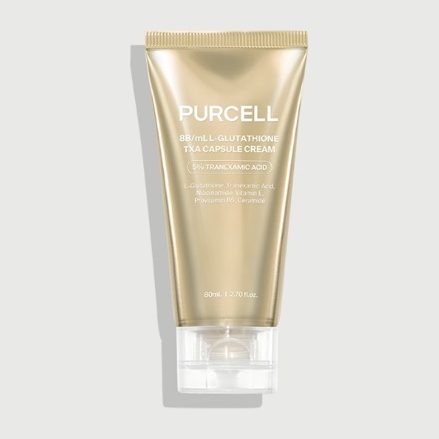
The one where tranexamic acid is the headline and the headline is honest, plus a marketplace claim that is not.
Tranexamic acid is third of 54 at 5 percent. That is the highest tranexamic figure among the products we are recommending from here, and the number in the product name matches the number in the ingredient list, which is the whole test a name like that has to pass.
Glutathione is fifteenth at 0.5 percent. That is 5,000 parts per million, and it is fifty times the glutathione in either product above. If you specifically want a glutathione level that is not a trace, this is the one on this page.
Now the part to watch. Niacinamide is fourth, and it carries no figure at all. A marketplace listing for this product advertises 5 percent niacinamide. Nothing on the label supports that number. The tranexamic claim is checkable and true; the niacinamide claim is a figure that exists only in the listing.
This is worth internalising, because it is a different failure from the usual one. The brand disclosed the ingredient its product is named for and left the other one blank, and a third party filled the blank in with a number.
The base is a proper emollient cream with macadamia oil, fatty alcohols, silicones and a ceramide, so unlike the two toners above it seals as well as treats. Adenosine sits at 35, blank as always.
Disclosed: tranexamic acid 5 percent, glutathione 0.5 percent. Niacinamide, no figure Fragrance-free: yes
Abib Glutathiosome Dark Spot Toner Skin Booster
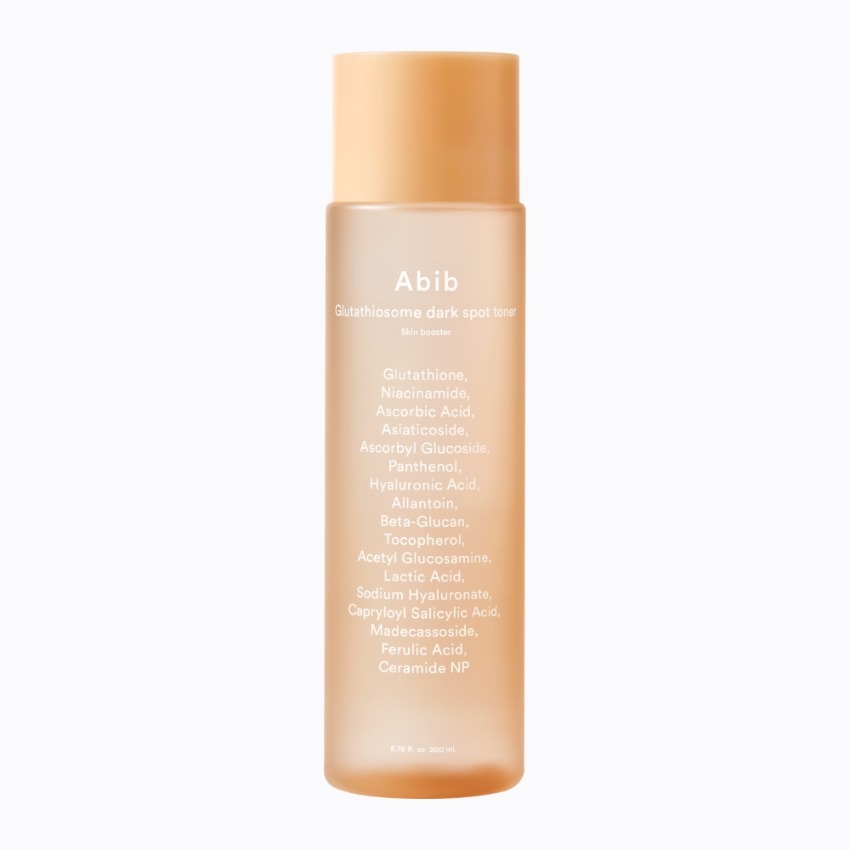
The floor of the glutathione ladder, on a product whose name is built entirely on it.
Niacinamide is fifth of 42 at 20,000 parts per million, which is 2 percent. Glutathione is seventeenth at 25 parts per million.
Twenty five parts per million is the smallest glutathione figure on this page, and the product is called Glutathiosome. So the ratio here is niacinamide at eight hundred times the glutathione, with the name belonging to the smaller one.
To the brand's credit, the label footnotes its own glutathione entry, and the note confines the exosome-style processing claim to raw material characteristics rather than to anything the finished product does. That is the qualification doing real work, and most readers will scroll past it.
Adenosine is at 13 with no figure, which is the third time on this page that the notified active is the blank one.
There is also an LHA at position 30 and lactic acid further down, both undisclosed, so this is not the acid-free toner the soothing framing suggests. If you are layering it with an exfoliating step, that is worth knowing.
Disclosed: niacinamide 2 percent, glutathione 25 parts per million Fragrance-free: yes
How to shop this category
Find the numbers and rank them. In all four products above, the ingredient with the largest printed figure is niacinamide or tranexamic acid, and in three of the four the product is named after something else.
Convert before comparing. One percent is 10,000 parts per million. The glutathione figures on this page run from 0.5 percent down to 25 parts per million, which is a spread of two hundred fold across four products all sold on glutathione.
Treat a missing number as a missing number, not as a small one. Arbutin appeared on 38 labels in our reading with no figure anywhere, and that tells you nothing about how much is there. It is unknowable from the outside, which is a different thing from being absent.
Expect the notified actives to be blank. Arbutin and adenosine are the two regulated ingredients in this article and neither carries a figure on any product here. A functional cosmetic filing tells you a filing was made; it does not tell you the dose, and we set out what those designations do and do not certify in what a Korean functional cosmetic label certifies.
And wear sunscreen, because every mechanism in this article works on pigment that ultraviolet exposure keeps re-starting. A tone routine without daily protection is arguing with itself.
Common questions
Does topical glutathione lighten skin?
We are not answering that from ingredient lists, and the oral and injectable literature people cite is a different route of administration. What we can say is that the glutathione levels printed on Korean labels run from 1 percent down to 1 part per million, so the products are not interchangeable even if you accept the premise.
Is tranexamic acid better than niacinamide?
They act at different points, which is why so many products carry both, and all four here do. Tranexamic acid is the one more often printed at a substantial level, which at least makes it comparable between products.
Why does glutathione need special packaging?
It converts to its disulfide form on exposure to air and light. That is ordinary chemistry. Several formulas in this category show awareness of it through chelators and encapsulation carriers, and container form is often not stated anywhere, so it is usually not something you can check.
Is arbutin worth looking for?
It is a notified whitening active and it acts on the enzyme that makes pigment, so the mechanism is real. The practical problem is that no label in our reading tells you how much it holds, so you cannot compare two arbutin products against each other at all.
What does a skin booster or capsule name mean here?
Nothing standardised. In this article those words describe texture and marketing position rather than a defined format, and the figures in the ingredient list are the only part of the name that has to be true.
If you have a brightening product and cannot tell which of its ingredients carries the real number, send us the listing and we will rank them for you.
Products mentioned
numbuzin
No.5 Glutathione C Mark Ampoule
Key Niacinamide, Panthenol, Tranexamic Acid
3 claims checked
Claims, checked
Niacinamide (50,000 ppm)
backed by evidenceNo. 5 Whitening/Blemish
plausible, not tested[Blemish Whitening]
nothing specific to check
Key Niacinamide 2%, Tranexamic Acid, Glutathione
4 claims checked
Claims, checked
Glutathione (Glutathione) + L-Cysteine + Cyanocobalamin + Tranexamic Acid
backed by evidence11 kinds of vitamin COMPLEX
backed by evidenceReal white jade whitening care containing special active ingredients!
partly backedA daily mild toner containing a heart that wants to tint you with a pink glow for dark spots and blemishes!
nothing specific to check
Key Tranexamic Acid 5%, Glutathione 0.5%, Niacinamide
3 claims checked
Claims, checked
TXA (Tranexamic acid 5%)
backed by evidence5% Niacinamide (Amazon listing)
no supporting source found8 billion/mL glutathione
nothing specific to check
It's registered in Korea as a functional cosmetic for brightening and wrinkle improvement.
Key Niacinamide, Glutathione, Adenosine
11 claims, summarized
- You can expect:
- less visible dark spots · softer-looking fine lines
- Only partly backed:
- a smoother skin texture (amount unknown) · better hydration · calmer skin
- Free of:
- the ingredients it lists
See each claim
Claims, checked
Smooth blemish care, Glutathiosome Toner
backed by evidenceDual functional cosmetic for whitening and wrinkle improvement
backed by evidenceBy using an exosomization method that places difficult-to-handle 98% purity glutathione into a plant-derived double lipid membrane form, it helps effectively absorb active ingredients deep into the skin.
plausible, not testedContains low-irritation exfoliating ingredient LHA to dissolve old dead skin cells between skin textures and help cultivate a transparent skin texture.
plausible, not tested5 types of hyaluronic acid are absorbed densely, creating a clear and transparent skin base from the first step after cleansing.
plausible, not testedContains 4 types* of moisture soothing booster to comfortably soothe irritated skin.
plausible, not testedWith a moist ampoule texture, it is gently absorbed into the skin, filling it with moisture from the inside to keep it moist.
plausible, not testedExperience skin that becomes even more transparent with a blemish toner that is absorbed closely and densely along the skin texture.
partly backedThe niacinamide ingredient helps to relieve pigmentation on the skin surface, and the PlusSome® Vita C and Glutathiosome ingredients help with skin vitality care.
partly backedEven sensitive skin can experience transparent skin every day without worry.
partly backedThe first step to transparent skin
nothing specific to check