In microbiome skincare, microbiome is not an ingredient
Across 703 Korean labels whose full ingredient list we hold, not one prints microbiome as an ingredient. Here is what that word becomes once you read the list.
The microbiome is the community of microbes living on your skin. It is already on your face, and it is not a thing sold in a bottle.
So it does not appear in ingredient lists. We read 703 Korean labels whose full list we hold, and not one of them prints microbiome as an ingredient.
Two products carry microbiome in the name. Both print a different word in the list.
What that other word is, and how far the evidence behind it goes, is this article.
The word on the front changes name in the list
It becomes a ferment. Microbes are grown in a medium, and what comes out is either filtered or broken open and used. Labels name it one of three ways.
- Ferment filtrate is the culture liquid with the microbial bodies filtered out.
- Ferment lysate is the cells burst open so their contents are released.
- Ferment or ferment extract are looser terms than either.
None of the three is a living culture. Living bacteria almost never go into Korean cosmetics. They do not survive preservation and distribution well, and if they did survive, that would be its own problem.
We read 155 labels carrying something in this family, counting the lactobacillus, bifida, galactomyces and yeast sides together. This is not a rare ingredient class on Korean shelves.
Printing an amount is rare here too
Of the labels in this family, six print an amount on the lactobacillus side, three on the bifida side and three on the galactomyces side.
But this class differs from other ingredients in one way that matters. The disclosed numbers are spread further apart than anywhere else.
- Some labels print parts per billion.
- Some print figures in the nineties as percentages.
Those are numbers on the same ingredient class, separated by orders of magnitude you cannot guess at. In this family, assume nothing before you see the figure.
The reason is what a ferment is. A ferment filtrate is itself mostly water, so it can replace the water phase entirely, and then the figure climbs into the nineties. It can equally be dosed in at a trace. Both uses print on the label as ferment filtrate.
A figure in the nineties does not mean the active is in the nineties. It means the filtered culture liquid is. The same problem of water and extract sharing one name shows up in what a rice toner actually does.
How far has this been shown in people?
The field is filling in quickly, and knowing the exact shape of what has filled in is the useful part.
There is a human trial. Forty two participants with oily skin applied a cream containing 3 percent lactic acid ferment lysate twice daily for 60 days. At day 60, sebum, porphyrins and pore size were reported down and hydration and texture up.
It was a pilot trial with no control arm, and the authors described it that way. Because everyone applied one cream for 60 days, that design cannot separate what the ferment did from what the cream did.
There is a systematic review. A 2026 review of prebiotics, probiotics and postbiotics for acne pooled 33 studies covering 2,112 patients, and reported that safety was favorable throughout. Seven of those studies covered postbiotics.
And there are a lot of cell studies. Bifida ferment lysate raising barrier gene expression in keratinocytes, galactomyces ferment filtrate acting on the junctions between cells. Those results happened in culture dishes. They are not statements about a face.
The summary is this. At the class level, human evidence has started to appear. At the individual product level it is almost all mechanism. And the trial above ran at 3 percent. Take that number to the shelf.
What five labels actually print
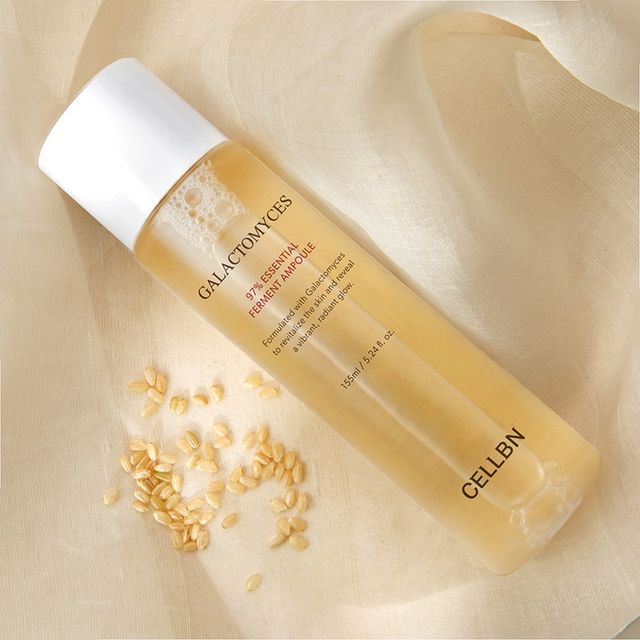
Galactomyces Ampoule 97 prints galactomyces ferment filtrate at 97 percent. There are nine ingredients total and no water entry at all, which is what it should look like when a ferment filtrate replaces the water phase. The 97 and the list agree with each other.
Putting the number in the product name is a slightly different act. 97 percent is the proportion of filtered culture liquid, not of active. And the niacinamide in second position and the adenosine in seventh carry no amount at all, which are the figures you would actually want.
PeachMicrobiome 78 PDRN Toner says it uses lactobacillus ferment lysate at 78 percent in place of water, first of 21 entries. The disclosure itself is generous.
Three sentences on the same page do not check out.
- The ingredient marketed as vegan PDRN is hydrolyzed ovum DNA. Ovum means egg, so calling an egg derived ingredient vegan works against the ingredient's own name. It sits last of the 21 at 11ppm.
- Asked whether the product contains fragrance, the brand answers no. Fragrance is printed twentieth on that same page's ingredient list.
- A sentence promising a visibly stronger barrier with consistent use names no duration and no measurement.
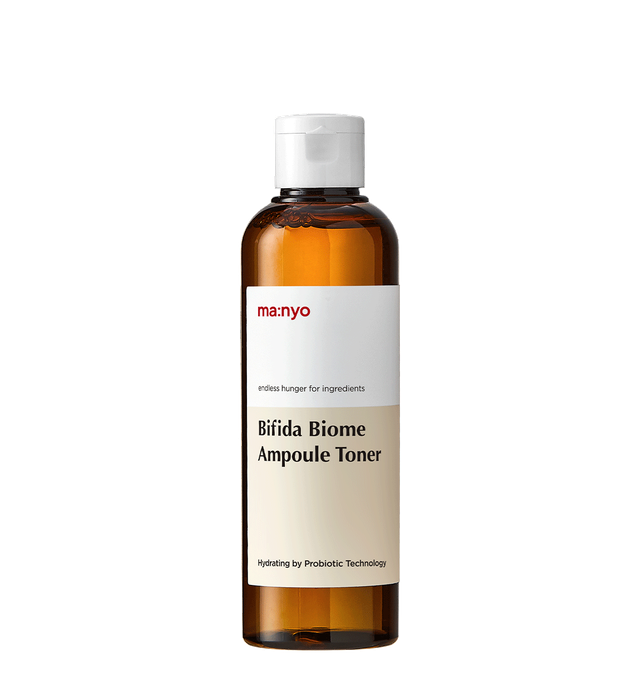
Bifida Biome Ampoule Toner prints all three of its figures: bifida ferment lysate at 38ppm, cutibacterium granulosum ferment extract filtrate at 10ppb, and bifida ferment filtrate at 2ppb.
That disclosure is the honest kind. And being honest, it tells you something. 2ppb is a trace. It is a different order of magnitude entirely from the 3 percent in the pilot trial above.
The list also carries fructooligosaccharide, a sugar that feeds bacteria, which is the class these products call a prebiotic. No fragrance and no essential oil appear among the 41 entries.
One gap is worth naming. Lactobionic acid sits twenty sixth. It is a polyhydroxy acid, so the suitable for all skin line does not sit perfectly clean.
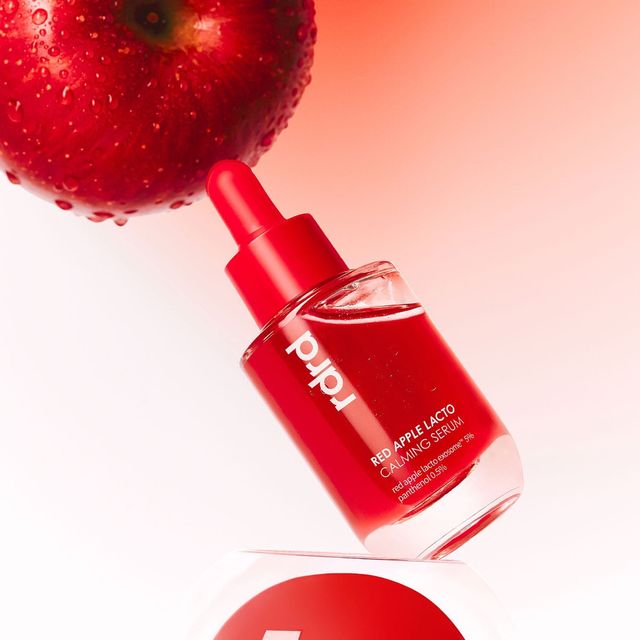
Red Apple Lacto Calming Serum prints lactobacillus ferment at 48,950ppm, about 4.9 percent, fourth in the list. Apple water follows at 37,240ppm in fifth.
This is the closest of the five to the concentration the pilot trial used. That does not guarantee a result. The trial used a different ferment lysate and had no control arm, and this is a different product. What is unusual here is simply that you can hold the numbers side by side at all.
The emergency soothing wording promises speed, and nothing measures speed. Panthenol, trehalose and a cooling agent are genuinely on the list.
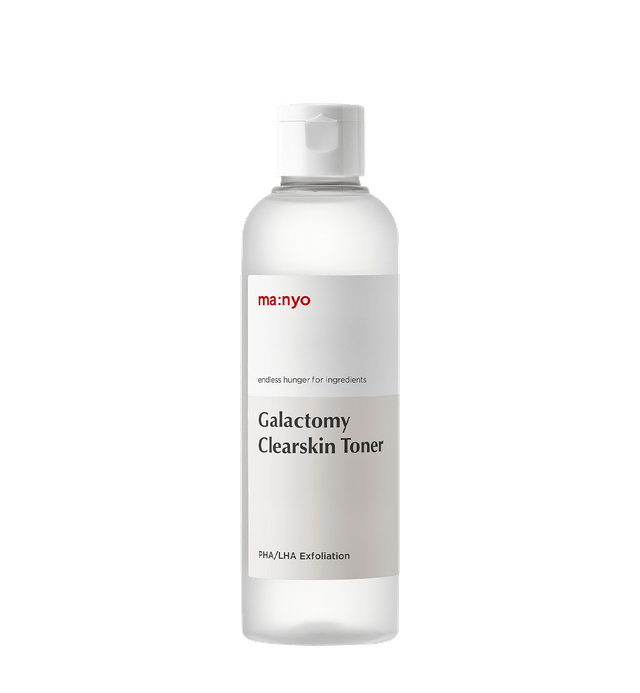
Galactomy Clearskin Toner prints galactomyces ferment filtrate at 500ppm, which is 0.05 percent.
This is where the category goes wrong most often. The brand copy credits galactomyces with removing dead skin cells. The ingredients doing exfoliating work here are gluconolactone in ninth position and capryloyl salicylic acid in twenty second, a PHA and an LHA. The sentence hands the ferment the acids' job.
Neither acid discloses a concentration, and the mildly acidic wording comes with no pH figure. What those two acids actually do is split out in what PHA actually is and LHA versus BHA.
What to check on a microbiome product
- Skip the word on the front and find the name in the list. It will say filtrate or lysate, and it will say which organism.
- If there is a figure, convert the units. Parts per billion, parts per million and percent all appear inside this one category. Nowhere else makes unit checking this important.
- A figure in the nineties means base, not active.
- Prebiotic means food. Look for an oligosaccharide or inulin entry in the list. Like a free from list, this is something you can confirm on the label yourself, using the method in free from lists versus ingredient lists.
Common questions
Are there cosmetics with live cultures in them?
Almost none on Korean shelves. What gets printed is an already processed form such as a filtrate or a lysate. Recent reviews also lean the same way, treating processed forms as better than live ones on stability and safety grounds.
Does microbiome skincare change the bacteria on my skin?
The pilot trial above reported a shifted microbial composition at 60 days. The authors described that analysis as hypothesis generating. And whether a shifted community is why the skin improved is not something that design can establish.
Should I just pick the highest number?
Within the same organism and the same form, the comparison is worth making. Comparing 97 percent filtrate against 38ppm lysate is not a comparison at all, because they are doing different jobs. One is the base and the other is an addition.
Does it help acne prone skin?
There is a review, and safety came out favorable. But most of the studies it pooled were either oral or, where topical, tested at the ingredient level rather than as a finished product. Carrying that over to a specific bottle goes further than the review does.
Is it fine for sensitive skin?
Ferments themselves are not classed as irritants. But as above, products in this category sometimes carry acids or fragrance alongside. For reactive skin the thing to read is the whole list, not the category on the front.
If you are holding something labelled microbiome and cannot tell which line in the list that word refers to, send us the product page. We will find it with you.
Products mentioned
Laboreve
PeachMicrobiome 78 PDRN Toner
We checked 10 lines this product advertises against the ingredient list and public documents. None of them hold up on their own. They are partly right at best.
3partly backed4overstated2no evidence1says nothing
See the label check (10 lines)
Claims translated from Korean, originals preserved.
- 78% PEACH FERMENT] Formulated with 78% peach ferment instead of water, this toner delivers lightweight hydration and promotes smoother, vibrant-looking skin. The nutrient-rich peach ferment leaves skin soft, supple, and refreshed.
- MILKY TONER TEXTURE] A soft milky toner texture glides onto the skin and absorbs quickly without a sticky finish, leaving skin comfortably hydrated and ready for the next step.
- Is this toner suitable for sensitive and dry skin? Formulated with Panthenol to calm and strengthen reactive skin, while the 78% fermented lactobacillus base supports the skin barrier. As always, we recommend a patch test before first use, especially for highly sensitive skin types.
- VEGAN PDRN] Infused with vegan PDRN, this formula works to support the skin barrier and maintain overall balance, leaving the complexion feeling resilient and comfortable.
- FOR SENSITIVE SKIN] Created for delicate skin, this toner helps calm the look of stressed skin and provides gentle daily care for a balanced, refreshed skin appearance.
- It blends PDRN into peach-derived lactobacillus ferment lysate to help with skin soothing, recovery of damaged cells and promotion of skin regeneration
Korean original
복숭아 유래 락토바실러스 발효 용해물에 PDRN 성분을 배합해 피부 진정과 손상 세포 회복, 피부 재생 촉진에 도움을 준다
- 'Peach Microbiome 78 PDRN Toner' is a product that adds PDRN to peach-derived lactobacillus ferment lysate to raise the skin soothing and damaged cell recovery effects
Korean original
'피치마이크로바이옴 78 피디알엔 토너'는 복숭아에서 유래한 락토바실러스 발효 용해물에 PDRN 성분을 더해 피부 진정과 손상 세포 회복 효과를 높인 제품이다
- Does this toner contain artificial coloring or fragrances? No. The soft peach tone of the toner comes entirely from its natural formulation, not from artificial dyes or fragrances. Every ingredient is chosen to be gentle and skin-friendly.
- Why should I use this toner? Laboreve Peach Toner uses 78% Lactobacillus Ferment Lysate as its base, concentrated probiotic essence, not diluted hydration. With consistent use, expect a visibly stronger, more resilient skin barrier over time.
- KOREAN SKIN CARE] Inspired by modern Korean skin care routines, this peach-powered toner highlights nourishment and glow for a radiant, balanced-looking finish.
CELLBN
Galactomyces Ampoule 97
We checked 3 lines this product advertises against the ingredient list and public documents. One of them holds up. The rest are only partly right or have nothing behind them.
1backed2partly backed
See the label check (3 lines)
Claims translated from Korean, originals preserved.
- Galactomyces Ferment Filtrate (97%)
Korean original
갈락토미세스발효여과물(97%)
- Galactomyces Ampoule 97
Korean original
갈락토미세스 앰플97
- [Large Size/High Concentration] Cellbien Galactomyces Ampoule 97 155ml
Korean original
[대용량/고함량] 셀비엔 갈락토미세스 앰플97 155ml
Ma:nyo
Bifida Biome Ampoule Toner
We checked 2 lines this product advertises against the ingredient list and public documents. None of them hold up on their own. They are partly right at best.
1likely1no evidence
See the label check (2 lines)
Claims translated from Korean, originals preserved.
- For all skin types
Korean original
모든 피부용
- Firmly from the root! 1st root ampoule toner
Korean original
근본부터 탄탄하게! 1등 근본 앰플 토너
rdrd
Red Apple Lacto Calming Serum
We checked 2 lines this product advertises against the ingredient list and public documents. One of them holds up. The rest are only partly right or have nothing behind them.
1backed1likely
See the label check (2 lines)
Claims translated from Korean, originals preserved.
- Red Apple Lacto
Korean original
레드 애플 락토
- Emergency Calming
Korean original
응급진정
Ma:nyo
Galactomy Clearskin Toner
We checked 10 lines this product advertises against the ingredient list and public documents. None of them hold up on their own. They are partly right at best.
4likely1partly backed2overstated2no evidence1says nothing
See the label check (10 lines)
Claims translated from Korean, originals preserved.
- Low-pH toner for smooth skin
Korean original
매끈한 피부를 위한 약산성 토너
- Gently exfoliates the skin
- LHA, Dissolve in oils, fats and lipids
- PHA, Effectively exfoliates dead skin cells on the surface
- Start on a clean slate a.k.a. clear skin! The Galactomy Clearskin Toner is rich in protein and minerals, using LHA and PHA to gently exfoliate the skin.
- Galactomices Fermentation Filtrate, Removes dead skin cells, manages pores and balances oil and moisture levels
- Galactomyces have been proven to effectively improve skin texture.
- Visibly refines skin texture
- Helps reduce excess sebum for clear skin!
- Balances skin's natural oil & moisture levels