Pregnancy and Korean skincare: it is mostly the BHA, not the retinol
Of the Korean labels we screened, 121 carry a commonly cautioned ingredient. Three fifths of those are salicylates, and most are cleansers and toners.
Before anything else: this is a reading guide for ingredient lists, not medical advice. What is safe in your pregnancy is a question for your own doctor or midwife, who knows things a label cannot. What we can do is help you find what is actually in the bottle so that conversation starts from facts.
With that said, here is the thing the internet gets backwards.
We screened every Korean label in our set against the ingredients commonly listed as pregnancy cautions. 121 products came back carrying at least one. Broken down by class, counting products rather than mentions. A few products carry two classes at once, so these do not add up to 121:
- Salicylates: 72. Salicylic acid, capryloyl salicylic acid, betaine salicylate.
- Retinoids: 28. Retinol, retinaldehyde, retinyl palmitate.
- Essential oils: 15. Sage, peppermint, clary sage, mugwort, tea tree.
- Bakuchiol: 5, flagged as retinoid adjacent rather than as a retinoid.
- Brightening actives: 3. Kojic acid, arbutin.
So roughly three fifths of the flags are salicylates, and retinoids are a distant second. Most people going through their bathroom cabinet are looking for a retinol serum. The more common hit is the acne cleanser and the pore toner they never thought about.
What does the screen actually mean?
It is worth being precise, because an empty result is easy to over read.
When a label comes back clear, what happened is that the printed ingredient list was read against a checklist: retinoids, salicylates, hydroquinone and arbutin type brighteners, certain UV filters. Nothing matched.
That is not a clinical clearance. It is a statement about one list of words. It does not cover fragrance sensitisation, it does not cover how much of anything is in there, and it certainly does not cover you specifically.
It is also not evenly documented. Of the 554 labels that came back clear, 205 carry a written note recording that the screen ran and what it looked for, which is under two in five. The rest simply have nothing recorded either way. We would rather say that plainly than imply every clear result was audited.
celimax Retinol Shot Tightening Serum
The best behaved brand in this article, and it still gets the reason wrong. That is why it goes first.
Retinol is disclosed at 0.1 percent at position 15 of 42, which is a real and checkable level, and this is a genuine retinoid product rather than one wearing the name.
The brand prints its own pregnancy advisory, which almost nobody does. It says it does not recommend use during pregnancy or breastfeeding. The direction of the advice is right and we want to give full credit for it existing at all.
The reason it gives is wrong. The page attributes the caution to hormonal changes making skin more sensitive during that period. That is a comfort argument. The actual reason topical retinoids are avoided in pregnancy is caution about vitamin A class risk to the developing baby, which is a completely different kind of concern.
Why this matters practically: a reader who accepts the stated reason could reasonably conclude the caution is about irritation, and that they can trade it off if their skin feels fine. The real reason is not one you can feel your way past.
A second claim on the page is well built and still limited. A 24 hour patch test on 31 adults at a named clinical centre with stated dates returned an average skin reaction of 0.00. That is a real method with a real panel. It measures acute contact irritation, not the cumulative retinoid adjustment the brand's own guidance describes over the first two weeks.
Caution ingredient: retinol, disclosed at 0.1 percent Brand warns: yes, for the wrong reason
Theralogic Retinal Wrinkle-Elasticity Cream
A disclosed retinoid at a substantial level, sold to everyone.
Retinaldehyde is at position 19 of 36, printed at 3,000 parts per million, which is 0.3 percent. Retinaldehyde converts to the active form in fewer steps than retinol, so this is at the strong end of what you can buy.
The spec block says all skin types. That line sits in the mandated product information table rather than in ad copy, which makes it worse rather than better: it is a field a responsible distributor fills in, and it has been filled in with a blanket that the formula does not support. Retinaldehyde at a disclosed 0.3 percent has a documented initial irritation profile, and no tolerance or patch test for this product is published.
The directions are the other gap. They say to take an appropriate amount and spread it evenly, with no frequency and no night only instruction on a 0.3 percent retinal cream. Someone new to retinoids following that literally will have a bad two weeks.
Six peptides sit at positions 26 and 29 to 33, which supports the anti-wrinkle framing in principle, though none of them carries a level.
Caution ingredient: retinaldehyde, disclosed at 0.3 percent Brand warns: no
Bioheal BOH NAD Freeze Cell Retinal Eye Cream
A retinoid at a trace level, on the thinnest skin on the face, sold to everyone.
Retinaldehyde is at position 45 of 67, printed at 10 parts per million, which is 0.001 percent. That is three hundred times smaller than the cream above.
We are including it for two reasons that pull in opposite directions, and both are worth holding.
The disclosed level is very small. A reader worried about retinoid exposure should know that 10 parts per million and 0.3 percent are not the same purchase, and the brand printing the figure is the only reason anyone can tell.
And the all skin types line is still unsupported, more so here than anywhere else in this article. It is a tolerability claim attached to a retinoid applied to eyelid skin twice a day, with no patch test, no dermatological or ophthalmological test, no participant count and no endpoint published anywhere.
If you are pregnant and looking at this product, the useful fact is the one the label gives you: the retinoid is present, at a disclosed trace, and the decision is still your clinician's rather than the box's.
Caution ingredient: retinaldehyde, disclosed at 10 parts per million Brand warns: no
Torriden Balanceful Cica Pore Cleansing Foam
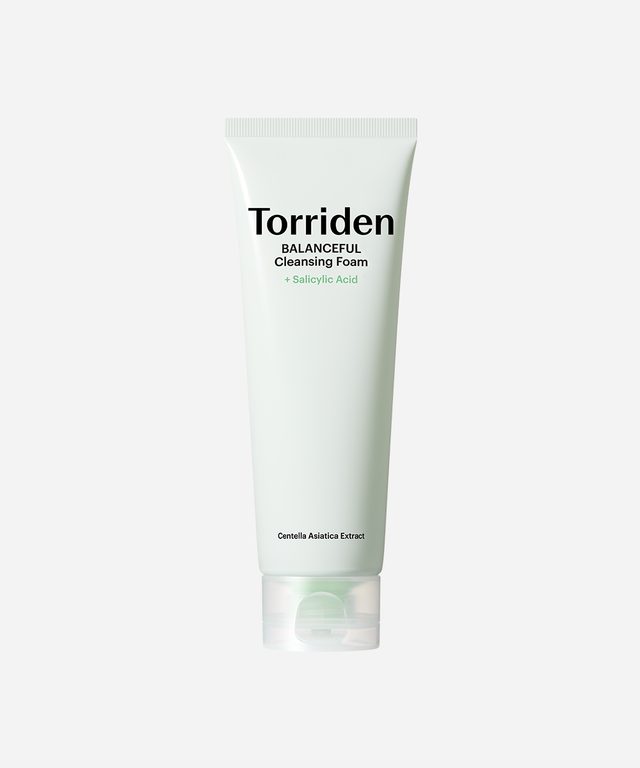
The category people forget, and the reason we put salicylates at the top of this article.
Salicylic acid is at position 13 of 42. No level is disclosed.
This is a cleanser, sold on soothing and pore care, with centella in the name. It is not a product anyone mentally files under things to check during pregnancy, and it is exactly the kind of product that makes up the 64 salicylate flags in our screen.
The spec table says all skin types. The mild co surfactant trio at positions 8, 10 and 11 is genuine, so the wash is not harsh. But a fatty acid trio with an alkali interleaved at position 7 is the signature of a saponified base, which cannot be held below neutral, and that is a real constraint the blanket line ignores.
Two useful practical notes. A rinse-off gives far less exposure than a leave-on, which is a genuine difference and one your clinician will weigh. And this product is flagged as fragranced even though there is no fragrance entry on the list at all, because the only aroma material is rosemary leaf oil at position 40 of 42. That is the flag counting an essential oil as fragrance, which we explain in fragrance-free, with sixteen essential oils.
Caution ingredient: salicylic acid, no level disclosed Brand warns: no
Dr.Althea 345 Relief Spot Powder
Six acids, no levels, no pH, and a denatured alcohol base.
Salicylic acid is at position 10 of 42. Then glycolic acid at 11, gluconolactone at 14, tartaric acid at 15, malic acid at 16 and lactic acid at 20. Denatured alcohol is second and calamine third.
Not one of the six acids carries a disclosed level, and no pH is published. The pH is the number that decides whether the acids act at all, which we went through in LHA or BHA, so this label leaves you unable to bound either the dose or the activity.
Tea tree oil sits at 22, which is a second flagged class on the same product, and there is no fragrance entry despite that.
As a construction this is the classic settling drying suspension: calamine and titanium dioxide suspended in an alcohol and water base, dabbed on a spot overnight. That is a real and old formulation type and it works for what it is. The salicylate is what puts it on this page, and the fact that a spot treatment is used on a small area rather than the whole face is another thing worth mentioning to your clinician rather than deciding alone.
Caution ingredients: salicylic acid, tea tree oil. No levels disclosed Brand warns: no
How to read your own shelf
Start with the cleansers and toners, not the serums. Three fifths of the flags in our screen were salicylates, and they live in acne washes, pore toners and cleansing pads far more than in anything marketed as a treatment.
Learn the four salicylate spellings, because they look different on a list: salicylic acid, capryloyl salicylic acid, betaine salicylate, and willow bark extract or water.
Learn the four retinoid spellings too: retinol, retinal or retinaldehyde, retinyl palmitate, and retinyl retinoate. A product can carry three of them at once, and one on this page carries a disclosed one plus two undisclosed ones.
Weigh leave-on against rinse-off. A salicylate in a wash you use for thirty seconds is a different exposure from the same molecule in a serum you leave on all night. That difference is real and it is one of the first things a clinician will ask about.
Note that bakuchiol shows up in this screen too, on five products, flagged as retinoid adjacent rather than as a retinoid. It is not a vitamin A derivative, and that is not the same as a clearance.
And then take the list to a person. The label can tell you what is in the bottle and roughly how much, and that is genuinely all it can do. Everything after that is a medical question. For what the retinoid class is and how the four forms differ, starting retinol has the background.
Common questions
Is salicylic acid in a face wash a problem?
It is the most common flag in our screen, and rinse-off exposure is much lower than leave-on. Whether that matters for you is a question for your clinician, and the useful thing you can do first is find out whether the acid is there at all, since most people do not know their cleanser carries one.
What about bakuchiol as a retinol alternative?
Bakuchiol is not a vitamin A derivative, so it does not carry the retinoid caution for that reason. It appears in this screen on five products anyway. And several products combine bakuchiol with an actual retinoid, so read the whole list rather than the marketing.
Are essential oils a pregnancy concern?
Fifteen products in our screen were flagged for one, most often mugwort oil, and the flagged oils are a small and specific set rather than essential oils in general. This is firmly a question for a clinician rather than a label.
Is niacinamide or hyaluronic acid on the list?
Neither appeared as a flag anywhere in our screen. They are the ingredients most routinely considered acceptable in topical use, which is why so many pregnancy-safe routines end up built around them.
If the ingredient list looks clear, is the product safe?
A clear result means the printed list was read against a checklist and nothing matched. It is not a clinical clearance, it says nothing about how much of anything is present, and about three in five of the clear results in our set carry no written record of the screen at all. Treat it as a starting point.
If you have a product and cannot work out whether it carries a salicylate or a retinoid, send us the listing and we will find every spelling of both on it.
Products mentioned
celimax
Retinol Shot Tightening Serum
We checked 8 lines this product advertises against the ingredient list and public documents. 2 of them hold up. The rest are only partly right or have nothing behind them.
2backed2likely1partly backed2overstated1says nothing
See the label check (8 lines)
Claims translated from Korean, originals preserved.
- Functional cosmetics for wrinkle improvement
Korean original
주름개선 기능성 화장품
- If you have adapted to retinol, from the 3rd week onward, take an appropriate amount and apply it evenly over the entire face every evening.
Korean original
레티놀에 적응이 되었다면 3주차 부터는 매일 저녁 얼굴 전체에 적당량 덜어 펴 발라 주세요
- Tightening
Korean original
타이트닝
- As a result of a 24-hour patch test on sensitive skin, the average skin reaction was 0.00, and it was judged as low (no) irritation.
Korean original
민감성 피부에 대한 24시간 첩포 테스트 결과, 평균 피부 반응도는 0.00으로 저(무)자극으로 판정되었습니다
- Pregnant women and nursing mothers are not recommended to use because the skin becomes sensitive due to hormonal changes.
Korean original
임산부, 수유부는 호르몬 변화로 인하여 피부가 예민해지는 시기로 인해 사용을 권장하지 않습니다
- With just one use, absorption depth improved by 797.51%
Korean original
1회 사용 만으로, 흡수 깊이 797.51% 개선
- With 2 weeks of use, overwhelming 4-fold pore improvement
Korean original
2주 사용으로 압도적인 4중모공 개선
- Shot
Korean original
샷
Theralogic
Retinal Wrinkle-Elasticity Cream
We checked 3 lines this product advertises against the ingredient list and public documents. None of them hold up on their own. They are partly right at best.
1likely1partly backed1overstated
See the label check (3 lines)
Claims translated from Korean, originals preserved.
- [Wrinkle Firming]TheraLogic Retinal Wrinkle Firming Cream 12g+ampoule4ml Special Set
Korean original
[주름탄력]테라로직 레티날 주름탄력 크림 12g+앰플4ml 기획
- Take an appropriate amount of this product and spread it evenly on the skin.
Korean original
본 품 적당량을 취해 피부에 골고루 펴 바릅니다
- All skin types
Korean original
모든 피부 타입
Bioheal BOH
NAD Freeze Cell Retinal Eye Cream
We checked 4 lines this product advertises against the ingredient list and public documents. One of them holds up. The rest are only partly right or have nothing behind them.
1backed1overstated2no evidence
See the label check (4 lines)
Claims translated from Korean, originals preserved.
- Retinal (10ppm)
Korean original
레틴알(10ppm)
- NAD FreezeCell Retinal Eye Cream
Korean original
NAD 프리즈셀 레티날 아이크림
- [NEW|Dark Circle Care] Biohealb NAD FreezeCell Retinal Eye Cream 25mL Double Set
Korean original
[NEW|다크서클케어] 바이오힐보 NAD 프리즈셀 레티날 아이크림 25mL 더블 기획
- For all skin types
Korean original
모든 피부용
Torriden
Balanceful Cica Pore Cleansing Foam
We checked 5 lines this product advertises against the ingredient list and public documents. One of them holds up. The rest are only partly right or have nothing behind them.
1backed2partly backed1overstated1says nothing
See the label check (5 lines)
Claims translated from Korean, originals preserved.
- Balanceful Cica Pore Cleansing Foam
Korean original
밸런스풀 시카 포어 클렌징 폼
- Balanceful Cica Pore Cleansing Foam
Korean original
밸런스풀 시카 포어 클렌징 폼
- Functional status: not applicable
Korean original
기능성 여부 해당없음
- All skin types
Korean original
모든피부타입
- Balanceful Cica Pore Cleansing Foam
Korean original
밸런스풀 시카 포어 클렌징 폼
Dr.Althea
345 Relief Spot Powder
We checked 2 lines this product advertises against the ingredient list and public documents. None of them hold up on their own. They are partly right at best.
1partly backed1says nothing
See the label check (2 lines)
Claims translated from Korean, originals preserved.
- Doctor Elcia 345 Relief Spot Powder
Korean original
닥터엘시아 345 릴리프 스팟 파우더
- 345