Ceramides need two other lipids before they repair anything
What ceramides do in the skin barrier, why cholesterol and fatty acids have to be there too, and how to read the amount on a label.
Ceramides are one of three fats that hold the outermost layer of your skin together, and a jar that lists them still has to bring the other two. Present and working are two different things.
You've probably bought a ceramide cream because your face felt tight and stung when toner went on. That symptom is real, and it points at the right layer.
Below: what the mortar is made of, why a ceramide feels good long before it repairs anything, and how to read the amount on a label.
What it does
Think of the top layer of your skin as a brick wall.
The bricks are dead, flattened cells, stacked fifteen or twenty deep and shed from the top as new ones arrive underneath. The mortar between them is fat, and it's the mortar that keeps water in and keeps irritants out. Ceramides are one part of that mortar.
Cholesterol and free fatty acids are the other two, and skin makes all three.
Pull one out and the mortar doesn't set. You get gaps. Water leaves through those gaps faster than it should, which is why a damaged barrier feels dry no matter how much you drink, and why it stings when anything acidic lands on it.
That's the whole mechanism, and everything below is downstream of it.
Ceramides at a glance
| Field | Value |
|---|---|
| Type | skin lipid, one of three barrier lipid classes |
| What it does | fills the fatty matrix between the cells of the surface layer |
| Who it suits | dry skin, tight or stinging skin, damaged barrier |
| How often | twice daily, morning and night |
| Pairs with | cholesterol, fatty acids, niacinamide |
| Don't pair with | no known conflicts |
That card hides the real question.
Ceramides don't conflict with much, which is why they show up in products meant for skin that's already unhappy. The question that decides whether yours is working sits one layer down, in what else the formula brought along.
Why isn't one lipid enough?
Because mortar is a recipe, not an ingredient.
The three lipid classes sit in the space between cells as stacked sheets, and the sheets need all three to stay ordered. Ceramides give the sheets their structure. Cholesterol keeps them from packing so tightly that the layer turns brittle, and the fatty acids sit alongside, holding the whole arrangement at a workable stiffness.
Add ceramides alone and you've delivered a third of a recipe.
That still isn't nothing.
Skin can use the ceramide it's given, and on mildly dry skin a ceramide-only product often feels better inside a week. The gap shows up in the harder cases.
If your barrier is properly wrecked, a formula carrying all three classes has more to offer than one carrying a trace of a single lipid.
The ingredient list is where you find out which one you bought.
Why does a ceramide cream feel good on day one?
Because most of that feeling isn't the ceramide.
Glycerin, butylene glycol, and propanediol pull water into the top layer within minutes, and the oils and butters over them slow how fast it leaves. You feel that as plumpness by the time you've brushed your teeth.
Barrier repair runs on a different clock.
Your skin replaces its outer layer over roughly a month, and lipid production happens inside cells on the way up, in a process nothing you spread on the surface can hurry along by much.
What a good cream does is cover the gaps while the wall rebuilds itself underneath. That is slower and less satisfying, and it's the part you actually paid for.
Give it four weeks.
Reading the label
Ceramide NP is the one you'll see most, with ceramide AP and ceramide EOP turning up alongside it.
The letters describe which fatty acid and which backbone got joined together. The differences matter to a formulator more than they matter to you.
Then there are the long names.
Hydroxypropyl bispalmitamide MEA and hydroxypropyl bislauramide MEA are pseudo-ceramides, built to sit in the same space and do a similar job, and brands often print them on the front as ceramide PC-102 or ceramide PC-104. That naming isn't a lie, but it is a shortcut.
Position on the list tells you less than you'd like.
Ceramides work at fractions of a percent, so a name sitting near the bottom of a list of forty is normal rather than damning. What position can't tell you is how much.
A few brands publish the number, usually in parts per billion, which sounds enormous until you convert it.
One part per million is a thousand parts per billion.
What do two real labels look like?
Aestura Atobarrier 365 Cream is the version with the whole recipe.
Its list of forty-two runs ceramide NP, two pseudo-ceramides, cholesterol, palmitic acid, and stearic acid, all sitting in the back half together. That's ceramides, cholesterol, and fatty acids in one formula.
The brand doesn't publish the ratio, so what the list supports is the presence of all three classes and not a claim about how well they're balanced.
It's also free of fragrance and colorant, which you can check yourself against the full list. For anyone whose barrier reacts to fragrance, that's the more useful fact on the page.
Some of the brand's copy goes further.
A retention percentage gets quoted right next to talk of barrier recovery, and the test behind that percentage was run on the raw material rather than on a face, which the page doesn't say. Read the list, not the banner.
TONYMOLY Ceramide Mochi Toner is the other case.
It discloses ceramide NP at 5,000 ppb, which works out to 5 ppm, or 0.0005 percent by mass, at position thirty-two of thirty-four. Publishing a number at all is more than most ceramide marketing does, and it deserves the credit.
Cholesterol and fatty acids aren't on that list.
So the softness this toner leaves behind is coming from the dipropylene glycol, glycerin, and propanediol near the top, plus the ester at number four and the macadamia seed oil at number seven. The brand line about ceramides filling moisture and nourishment at once is where the description parts ways with the list.
The toner works. The ceramide isn't why.
One more thing on that label deserves a mention.
Five fragrance oils are in there: lavandin, scented geranium flower, Mexican juniper, lavender, and lemon peel, with limonene and linalool declared separately. The brand describes the scent as a soft citrus, and four of the five aren't citrus, sitting above the lemon peel oil on the list.
If fragrance is your trigger, that's information the front of the bottle doesn't give you.
Who should skip the thick cream?
Oily skin in summer, at eight in the morning.
A heavy ceramide cream under sunscreen just sits there, and by noon you're shiny and faintly suffocated. Move it to night. A lighter lotion in the morning still puts lipids on your face, because they don't have to go on in a thick layer to go on at all.
There's a harder line too.
If your skin is weeping, cracked, or painful for days, that's past the point where a cream is the answer. See a dermatologist. Barrier language on a jar isn't built for that situation, and neither is anything else you can buy off a shelf.
TONYMOLY tells sensitive skin to patch test first, and that instruction is worth following on any product carrying five fragrance oils.
Go find the ingredient list of whatever ceramide product you already own. Look for cholesterol, and then look for a fatty acid.
If both of them are there, then you bought mortar rather than a bag of sand.
If they aren't, what you own is a decent moisturizer with a ceramide in its name, and that's still worth using.
We ran that same check across six Korean ceramide products and wrote down how much is actually in each one. If your skin is reactive as well as dry, the shortlist for that starts from a different filter.
Products mentioned
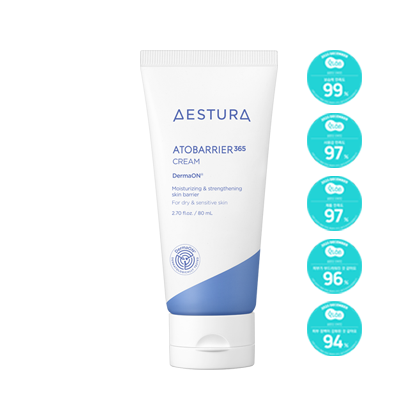
Aestura
Atobarrier 365 Cream
It's made for better barrier support and better hydration.
Key: Ceramide, Hydroxypropyl Bislauramide MEA, Hydroxypropyl Bispalmitamide MEA
11 claims, summarized
- Only partly backed:
- better hydration · better barrier support
- Free of:
- 9 listed ingredients
See each claim
claims, checked
Atobarrier 365 Cream does not contain ingredients generally known as ones pregnant women are concerned about.
backed by evidenceA moisturising cream that protects the skin barrier
plausible, not testedA high-moisture cream that strengthens damaged skin barrier function
plausible, not testedThis is the second generation Atobarrier 365 Cream, completed with ingredients specialised for sensitive skin.
plausible, not testedA product whose suitability for sensitive skin has been secured by completing three skin safety tests (dermatological, hypoallergenic, sensitive panel test)
plausible, not testedThe NEW cream has barrier protection function at 38.7%, strengthened from the previous 29.6%, and within 2 hours of use ceramide reached 10 skin layers, increasing surface moisture by 242% and inner moisture by 356%.
plausible, not testedDerma-On technology, evolved for daily care, strengthens the barrier function of dry and sensitive skin.
partly backedBoth products are free of artificial fragrance and synthetic colourant, and with a 9 FREE formula sensitive skin can use them comfortably.
partly backedPatented capsule technology was applied so that ceramide stays in the gaps of the barrier for a long time and can restore the damaged barrier, and 190% residue was confirmed even after cleansing compared with the non-capsule form.
overstatedAtobarrier 365 Cream is developed for sensitive and delicate skin to use, and anyone from age 0 to adults can use it.
no supporting source found#CapsuleCream #VisibleCapsules #MoistureBarrier
nothing specific to check
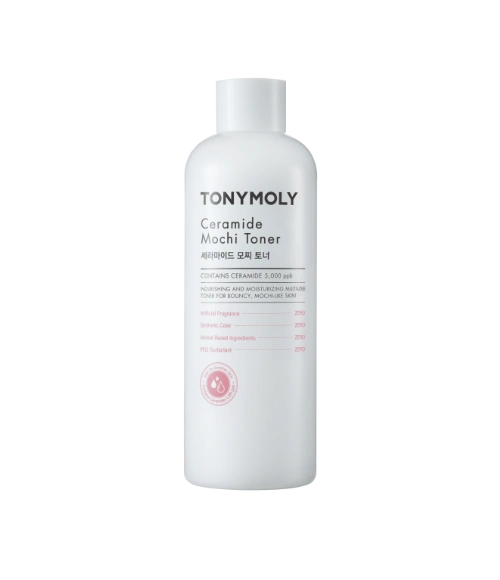
TONYMOLY
Ceramide Mochi Toner
It's made for better hydration.
Key: Ceramide, Panthenol, Centella Asiatica Extract
17 claims, summarized
- Only partly backed:
- better hydration
- Don't count on:
- firmer skin · better barrier support
- Tests passed:
- skin irritation
See each claim
claims, checked
Caution: a patch test is recommended for sensitive skin
backed by evidenceNot a functional product
backed by evidenceRecommended situations: when dryness is felt, when you want to keep the routine simple
plausible, not testedAs a wipe-off toner: dispense an appropriate amount onto a cotton pad, wipe gently along the grain of the skin, then pat lightly to absorb.
plausible, not testedIngredient points: ceramide, hyaluronic acid, panthenol, centella extract
partly backedDaily routine: the first step after washing (morning/evening)
partly backedFeel guide, recommendations by skin type: (oily/combination) a fresh wipe-off toner · (dry/inner dryness) a moist toner pack and layering
partly backedAs a moisturising pack: soak a cotton pad generously, place it on dry skin and remove after 10 minutes.
partly backedIt is a milky texture that balances oil and moisture. The ceramide ingredient does not sit on top of the skin but absorbs densely like mochi, leaving only a deep moisturised feel without stickiness.
partly backedUsing it as a 'toner pack' by soaking a cotton pad generously and laying it on dry areas for 5 to 10 minutes, or putting it in an empty bottle and spraying it frequently like a mist, helps create dense mochi skin.
partly backedIt is a viscous milky white texture, but the moment it touches the skin it spreads softly and absorbs quickly, raising the adherence of the next skincare step.
partly backedThe ceramide ingredient fills moisture and nourishment at the same time.
overstatedFragrance: a subtle citrus scent
overstatedYou can use it with confidence on sensitive and dry skin.
overstatedIt contains 5,000ppb of ceramide, which firmly cares for the skin barrier, protecting the skin from external irritation and blocking moisture evaporation.
overstated2 million units sold cumulatively! It is Tonymoly's flagship toner.
no supporting source foundIt is a product whose gentle feel was verified through a human application test.
no supporting source found