MILDLAB
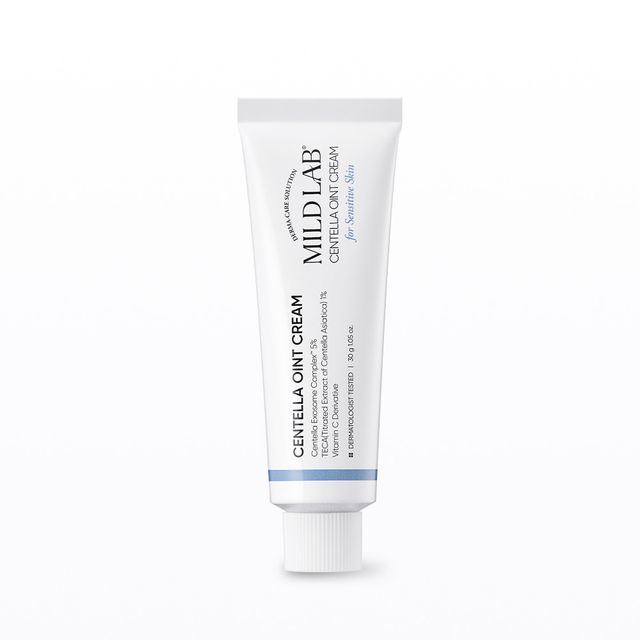
MILDLAB Centella Ointment Cream
Ingredient analysis and how the ad lines read
Read on 2026-09-11
What is this product?
Reach for this MILDLAB cream if the goal is a centella product that actually prints its numbers. Five entries carry amounts: centella leaf water at 5.0 percent in position 5, then the three titrated constituents, madecassic acid, asiaticoside and asiatic acid, at positions 12, 16 and 20, plus centella extract at 23. Six of the thirty nine entries are centella derived. Two cyclic silicones at 8 and 10 make it an occlusive ointment style cream rather than a light one, which suits the post extraction use the brand names but sits awkwardly with acne prone skin. Three things to know before trusting the numbers here. A renewal genuinely happened, since the brand's own page announces a Centella 2.0 upgrade, and the list below is bound to that generation by arithmetic rather than by a dated label. The list itself comes from drugstore retail, not from the brand. And the brand's headline panthenol and niacinamide amounts appear nowhere in the regulated disclosure.
What makes it different?
Quantitative disclosure is the differentiator this record can point to: five of the thirty nine entries carry printed amounts, and the three titrated centella constituents are individually broken out with figures rather than folded into a single extract entry. No category baseline for how often amounts are printed was measured here, so no comparison against one is made. The occlusive system is silicone based: two cyclic silicones at positions 8 and 10, with no plant butter, fixed oil or mineral oil anywhere in the list. A five entry vitamin tail closes the list, four vitamin C derivatives and one riboflavin phosphate at positions 35 through 39, all at trace depth. Sodium guaiazulene sulfonate at 33 is an uncommon water soluble azulene soothing agent.
What is in it?
The full ingredient list as the brand publishes it, in the printed order. Each name links to what we know about that ingredient.
This brand publishes its ingredient list in Korean only. Names below are the matching INCI names from the Korean Cosmetic Association ingredient dictionary, except 2 with no dictionary entry, left in Korean.
Key ingredient
- Water
- Dipropylene Glycol
- Butylene Glycol
- Glycerin
- Centella Asiatica Leaf Water
- Cetearyl Alcohol
- Niacinamide
- Cyclopentasiloxane
- Panthenol
- Cyclohexasiloxane
- 1,2-Hexanediol
- Madecassic Acid
- Glyceryl Stearate SE
- Hydroxyacetophenone
- Carbomer
- Asiaticoside
- Tromethamine
- Ethylhexyl Olivate
- Sodium Acrylates Copolymer
- Asiatic Acid
- Sodium Stearoyl Glutamate
- Polyglyceryl-4 Oleate
- Centella Asiatica Extract
- Adenosine
- Disodium EDTA
- Ethyl Hexanediol
- Propanediol
- Caprylyl Glycol
- Centella Asiatica Callus Extracellular Vesicles
- Polyglyceryl-10 Laurate
- Hydrogenated Lecithin
- Polyglyceryl-10 Myristate
- Sodium Guaiazulene Sulfonate
- Sodium DNA
- Sodium Ascorbyl Phosphate
- Magnesium Ascorbyl Phosphate
- 테트라헥실데실아스코베이트
- 소듐리보플라빈포스페이트
- Ascorbyl Glucoside
Ingredients with no mark are ones we found nothing notable about, and when marks overlap on one ingredient we show the caution first.
We could not place these in the list above: 폴리글리세릴-4올리에이트, 폴리글리세릴-10라우레이트, 폴리글리세릴-10미리스테이트, 글리세릴스테아레이트에스이, 세테아릴알코올
Did the ad claims hold up?
We checked 6 lines this product advertises against the ingredient list and public documents. One of them holds up. The rest are only partly right or have nothing behind them.
Claims translated from Korean, originals preserved.
backed by evidence1
- Standardized Centella Asiatica Extract 10,000 ppm
Korean original
병풀정량추출물 10,000 ppm
likely, not proven1
- All skin types
Korean original
모든 피부
partly backed2
- Panthenol 10,000 ppm
Korean original
판테놀 10,000 ppm
- Niacinamide 20,000 ppm
Korean original
나이아신아마이드 20,000 ppm
no evidence2
- Mild Lab #Centella 2.0 back stronger
Korean original
더 강력하게 돌아온 마일드랩 #센텔라 2.0
- Cumulative sales volume 360,000 units
Korean original
누적판매량 360,000개
Each line is quoted as the brand published it, and each one was read on its own against the ingredient list and the documents the brand publishes.