23YEARSOLD
23YEARSOLD BADECASIL P
Ingredient analysis and how the ad lines read
Read on 2026-09-12
What is this product?
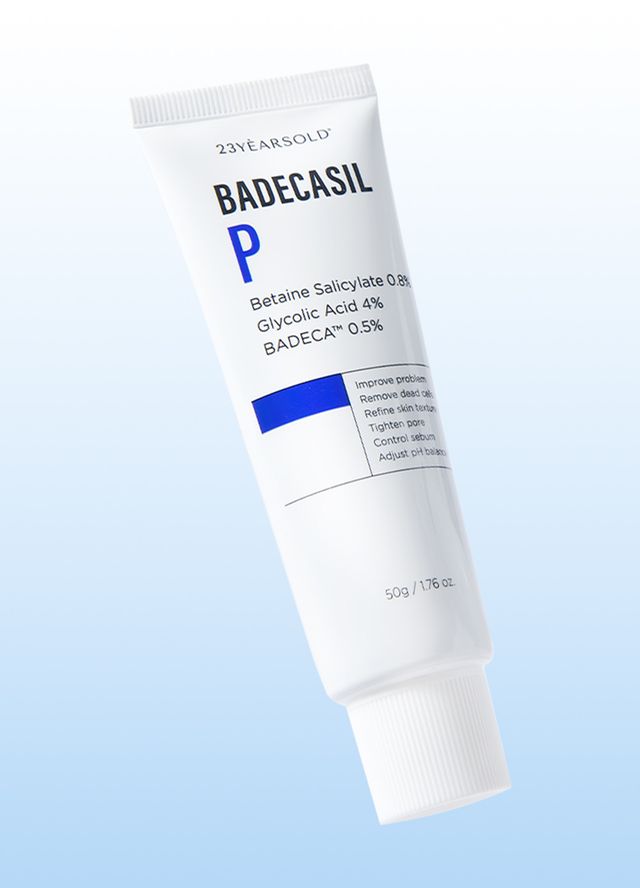
A 50 g exfoliating cream built on two disclosed acids: glycolic acid at position 3 of a 34-item statement with 4 percent printed on the package, and betaine salicylate at position 17 with 0.8 percent printed alongside it. Urea at position 20 adds a third route to softening dead cells, while centella, dipotassium glycyrrhizate, allantoin and panthenol sit mid-list as the calming set. The label is numerically generous and silent on the one number that matters most: no pH appears on any surface checked, and potassium hydroxide at position 10 shows the formula is neutralised to an unstated degree. Two trademarked complexes, BADECA at 0.5 percent and BioDtox, carry concentrations or functions without any corresponding entry on the ingredient statement. The brand's own footnote limits its ingredient claims to raw-material properties. The P in the name is a line-variant marker: a sibling D and a P-plus-D duo exist as separate catalogued products.
What makes it different?
The first separator is that the acid percentages are printed on the package rather than implied, 4 percent glycolic and 0.8 percent betaine salicylate, which lets a reader who knows their tolerance make an informed decision before buying. The second is the gap that transparency leaves open: no pH is published anywhere, and potassium hydroxide on the statement shows neutralisation happened, so the stated percentages cannot be converted into actual acid strength. The third is a pattern worth flagging to any reader weighing the marketing: the checkable claims on this page hold up well, while the uncheckable ones, a pharmacy ranking, a two-million sales figure, and two proprietary complexes with no disclosed composition, carry the most impressive-sounding numbers on the label.
What is in it?
The full ingredient list as the brand publishes it, in the printed order. Each name links to what we know about that ingredient.
This brand publishes its ingredient list in Korean only. Names below are the matching INCI names from the Korean Cosmetic Association ingredient dictionary, except 2 with no dictionary entry, left in Korean.
Key ingredient
- Water
- Butylene Glycol
- Glycolic Acid
- Pentylene Glycol
- Cetearyl Alcohol
- Glyceryl Stearate
- Cyclopentasiloxane
- Beeswax
- PEG-100 Stearate
- Potassium Hydroxide
- Cyclohexasiloxane
- Polysorbate 60
- Sorbitan Sesquioleate
- Dimethicone
- Propanediol
- Centella Asiatica Extract
- Betaine Salicylate
- Xanthan Gum
- Dipotassium Glycyrrhizate
- Urea
- Aspergillus Ferment
- Allantoin
- Panthenol
- 호바씨오일
- Disodium EDTA
- Aloe Barbadensis Leaf Extract
- 1,2-Hexanediol
- Ethyl Hexanediol
- Bioflavonoids
- Sodium Hyaluronate
- Brassica Oleracea Italica (Broccoli) Extract
- Galactoarabinan
- Phytosphingosine
- 참당귀추출물
Ingredients with no mark are ones we found nothing notable about, and when marks overlap on one ingredient we show the caution first.
We could not place these in the list above: Polysorbate 60, Sorbitan Sesquioleate, Glyceryl Stearate, PEG-100 Stearate, Cetearyl Alcohol, Cera Alba
Did the ad claims hold up?
We checked 13 lines this product advertises against the ingredient list and public documents. 3 of them hold up. The rest are only partly right or have nothing behind them.
backed by evidence3
- Betaine Salicylate 0.8%
- Glycolic Acid 4%
- * 원료적 특성에 한함
partly backed4
- ✅AHA 4%로 강력한 각질, 피지 조절
- Improve problem / Remove dead cells / Refine skin texture / Tighten pore / Control sebum / Adjust pH balance
- 베티안살리실레이트 - 각질과 피지 제거
- 글라이콜릭애씨드 - 각질 제거, 피부 순환주기 정상화
no evidence6
- 옵티마 약국 1위 크림 대용량 온라인 입점!
- ✅K-옵티마 약국 880개 지점 1위 크림
- ✅누적 판매량 200만!
- BADECA™ 0.5%
- 바데카™ - 불필요한 각질 제거, 매끄러운 피부 결
- BioDtox - 피부 과민 반응 진정
Each line is quoted as the brand published it, and each one was read on its own against the ingredient list and the documents the brand publishes.
What else is worth seeing?
Products we read alongside this one.