How to tell whether a mineral sunscreen will cast, before you buy it
Four label checks that decide white cast. Applied to the Korean mineral sunscreens we can read end to end, and both of them fail at least one.

You want a mineral filter, for whatever reason brought you here, and you do not want to walk out of a bathroom looking grey.
We should say the honest thing first, because it changes what this piece can be. In the Korean sunscreens whose ingredient lists we can read from the first entry to the last, there are exactly two mineral only products, and both of them will cast.
Neither carries a tint to offset it.
So this is not a list of mineral sunscreens that stay invisible. It is the four checks that decide the question, written so you can run them yourself on a product we have not read, plus what happens when we run them on the two we have.
Why does a mineral filter show at all?
Because it is a particle sitting on top of skin rather than a molecule dissolved into a film.
Zinc oxide and titanium dioxide block ultraviolet by scattering and absorbing it, and the same particles scatter some visible light along with it.
Your eye reads that scattered visible light as a pale film. The effect is strongest against deeper skin tones, because the contrast between the film and the skin underneath is larger.
Protection and visibility move together, which is the frustrating part. A higher particle load blocks more and shows more, and there is no way to have the first without engineering around the second.
The four checks
- How much zinc, if the brand says. Most do not. When a figure is printed, anything in the high teens as a percentage is a heavy load and you should expect a visible film. A brand that discloses this number is doing you a favor even when the number is inconvenient.
- Is there a tint. Look for iron oxides, or CI numbers, in the ingredient list. Tinted mineral sunscreens solve cast by adding color back, and it is the only reliable fix. A mineral product with no iron oxide and no pigment is telling you it has not addressed the problem.
- What the brand claims about particles. Non nano and micronized are marketing terms with no Korean regulatory definition and no required disclosure. If a brand asserts one without publishing a particle size or a testing lab, treat it as unverified rather than as a specification.
- Whether the SPF figure sits somewhere accountable. A rating printed in the mandatory product information block is a legally required disclosure. A rating that appears only on retailer or editorial listings is a weaker surface, and on mineral products it is worth checking because a full label reading is what tells you the filter load in the first place.
What happens when we run those checks
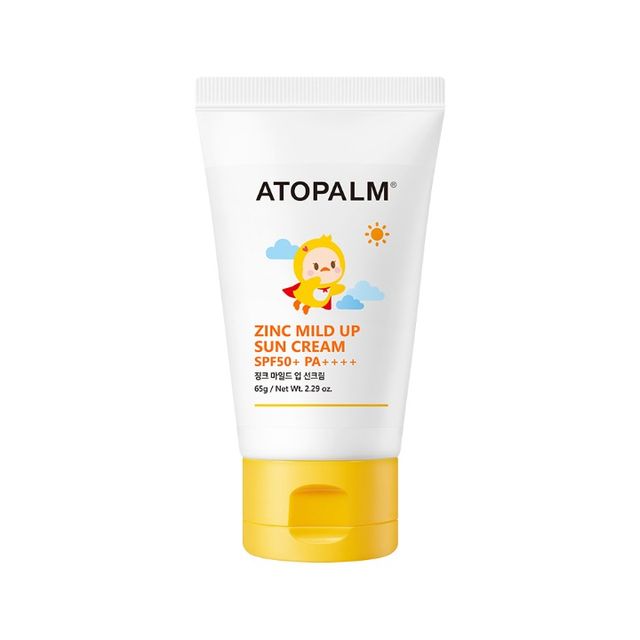
ATOPALM Zinc Mild Up Sun Cream SPF50+ PA++++ passes check one in the sense that matters most: it prints the number. Zinc oxide is disclosed at 192,000 parts per million, which is 19.2 percent.
That figure is the answer to the question this article asks. A load that high scatters a lot of visible light, and there is no iron oxide anywhere on the list to correct it, so check two fails.
The brand's own line about minimal white cast is the one claim on this product we would set aside, and the reason we can say so with any confidence is that the brand published the concentration that contradicts it.
Everything else about the product is better than that sounds. A four week trial on thirty three subjects reports water loss down twelve percent and moisture up fifteen percent, run by a named research center, and there is a dual function registration behind it.
The reason to think twice is elsewhere entirely: six essential oils are on the list, including sage, patchouli, cardamom, mint, chamomile and juniper.
Dr.G Green Mild Up Sun+ fails differently. Zinc oxide is the sole UV filter across forty ingredients, with no organic filter anywhere, which is exactly the construction someone avoiding organic filters is looking for.
No concentration is printed, so check one returns nothing.
- No iron oxide and no pigment appears, so check two fails here too.
- A non nano claim appears with no particle size and no lab attached, so check three is unverified.
- No official brand page for this product survived our collection, so the SPF 50+ PA++++ rating reaches us through retailer and editorial listings rather than a label reading, which is check four coming back weak.
There is a real virtue here worth keeping in view. No fragrance ingredient and no essential oil appears on the list, which is not true of the other mineral product above, and which makes this the better pick for anyone whose reason for wanting mineral is sensitivity rather than appearance.
The one that gets tagged mineral and is not
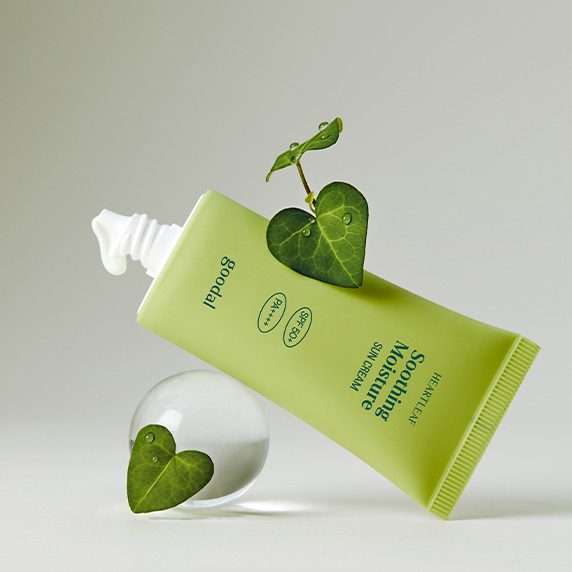
Goodal Clear Houttuynia Soothing Moisture Sun Cream is in this piece as a warning about shopping by category tag rather than by label.
At least one retailer files this product as a mineral sunscreen. There is no zinc oxide and no titanium dioxide anywhere on its twenty nine ingredients.
It runs four organic filters, which is why it does not cast, and it is a perfectly good sunscreen that is simply not the thing the tag says it is.
If you are avoiding organic filters deliberately, that tag would have sent you the wrong way. If you are only avoiding cast, the tag would have sent you past a product that solves your problem. Either way the ingredient list settles it in about ten seconds and the tag never does.
Filter type: organic, four filters Fragrance-free: yes
What would actually pass
- A tinted mineral sunscreen with iron oxides on the list, matched roughly to your depth. That is the mechanism, it is well understood, and it is why tinted versions of mineral formulas exist at all.
- Failing that, a lower zinc load with a disclosed figure, so you can at least predict what you are getting.
We have not read a Korean product end to end that meets either description, and we would rather say so than pad this piece with something we have not read end to end.
If your goal is simply no cast and the filter class is negotiable, the organic options do it by mechanism rather than by engineering, and we listed the ones we have read in Korean sunscreens that do not cast.
What cast is not
- It is not a measure of how well a sunscreen works. A filter you cannot see protects exactly as well as its rating says, and one you can see does not protect more because you can see it.
- It is not the same as a tone up finish. Tone up products add a brightening layer deliberately, usually with a pigment or a pearl, and people who dislike cast usually dislike those too.
- It is not permanent or fixed. Cast varies with how much you apply, and the quantity that actually delivers the number on the box is more than most people use, so the version of a product you see on your face is often a thinner version than the one that was tested.
Common questions
Does rubbing it in longer get rid of the cast?
It spreads the particles more evenly, which can reduce patchiness, and it does not remove them. Rubbing also thins the layer, which lowers the protection you actually get.
Will a mineral sunscreen suit me better if I am reactive?
Only if your history points at filters specifically. Fragrance and essential oils are the more common triggers, and one of the two mineral products above carries six of them. There is more on that in Korean sunscreens for sensitive skin.
Is titanium dioxide less visible than zinc oxide?
Not reliably. Both are white particles and both scatter visible light. What changes the outcome more is the total load and whether the formula carries a tint.
Can I just use less to avoid the cast?
You can, and you will get less protection in the same proportion or worse. If the appearance is the deciding factor, changing the product is the honest fix rather than changing the amount.
If you are holding a sunscreen and cannot tell whether it will show on camera, send us the listing and we will run these four checks on it with you.
Products mentioned
It's made for better barrier support and calmer skin.
Key: Zinc Oxide, Panthenol, Allantoin
9 claims, summarized
- Only partly backed:
- better barrier support · calmer skin (amount unknown)
See each claim
claims, checked
Gentle, reassuring protection with 100% zinc oxide
backed by evidenceSkin barrier recovery effect added! A mineral daily sunscreen you can trust, for sensitive skin
plausible, not testedA NON-NANO mineral sunscreen for delicate skin
plausible, not testedA skin barrier improvement effect confirmed by a human application study
plausible, not testedIrritation test on sensitive skin completed
plausible, not testedMINERAL UV BLOCKING INGREDIENTS used in this sunscreen diffuse and reflect UV rays by forming a physical barrier to reduce the burden on the skin
plausible, not testedSoothes and clams sensitive skin: Contains Allantoin and Houttuynia Cordata extract which are effective to soothe the sensitive skin due to ultraviolet heat.
plausible, not testedZinc Physical sunscreen with minimal of white cast that safely protects delicate skin.
overstatedAtopalm sunscreen is made of 100% Minerals and is safe to use from 6 months and above.
no supporting source found
Key: Zinc Oxide, Centella Asiatica Extract, Houttuynia Cordata Extract
11 claims, summarized
- Free of:
- the ingredients it lists
See each claim
claims, checked
Formulated without ingredients that might damage coral reefs.
backed by evidenceThe product is free from oxybenzone, octinoxate, and octocrylene.
backed by evidencePhysical sunscreen for sensitive skin. Refreshing and soft sun cream with mild ingredients that safely protects the skin from the light, heat and irritants.
plausible, not testedThe sunscreen boasts a worry-free hypoallergenic formula that can be used with confidence by those with sensitive skin.
plausible, not testedThe sunscreen features a 5-pronged protection mechanism, offering comprehensive defence for sensitive skin against UVA, UVB, blue light, infrared, and pollution.
plausible, not testedCentella Asiatica Extract along with Houttuynia Cordata Extract provide relief for sensitive skin
plausible, not tested100% zinc oxide, an even gentler mineral sunscreen!
partly backedPycnogenol along with Provitamin D promote skin health
no supporting source foundNon-nano sunscreen suitable for sensitive skin.
no supporting source foundDr.G's "Green Mild Up Sun+ SPF50+/PA++++" is a sunscreen that reflects Dr.G's dedication to providing safer products.
nothing specific to checkClean Beauty sun care specifically designed for sensitive skin.
nothing specific to check
Key: Diethylamino Hydroxybenzoyl Hexyl Benzoate, Ethylhexyl Triazone, Methylene Bis-Benzotriazolyl Tetramethylbutylphenol
4 claims checked
claims, checked
SPF50+ / PA++++
backed by evidenceReef safe
backed by evidenceMineral sunscreen
no supporting source foundSkin type: sensitive
no supporting source found