The Medi Dr.
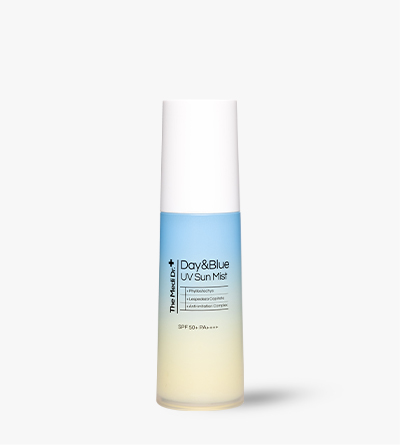
The Medi Dr. Day&Blue UV Sun Mist
Ingredient analysis and how the ad lines read
Read on 2026-09-12
What is this product?
A 50ml pump sun mist from The Medi Dr., built to be sprayed over a face that is already finished. Its label prints 36 entries with no disclosed concentration on any of them: water at 1, then seven organic UV filters at 2, 3, 5, 6, 7, 8 and 12, a film-forming set at 9, 10 and 11, cellulose thickeners at 14 and 16, and thirteen botanical entries between 21 and 36, including three aromatic plant oils, with three preservation materials threaded through them. There is no titanium dioxide, no zinc oxide, no ethanol and no fragrance entry. The statutory row registers one function, sun protection, and names its route as report under review exemption, with no filing number. The evidence problem is the grade: no SPF or PA string appears in the text of any archived page, the banner that printed one legibly carries a C2PA manifest identifying it as an Adobe Firefly composite titled Generated image, and the clean control image prints a grade row that does not resolve to characters at 24x. No SPF or PA value is carried in facts as a result. The brand publishes no application quantity and no reapplication interval for this product. A 6.5ml trial size sold under its own product code is a different formulation rather than a smaller pour.
What makes it different?
Two things set this record apart, and one of them is about the product while the other is about the evidence. On the product: a sun mist whose panel carries seven organic filters and no mineral filter at all, with no ethanol and no added fragrance, then thirteen botanical entries including three aromatic oils. On the evidence: this is the record where a brand's own detail banner was found to be a generative composite carrying label-looking SPF and PA text, which was removed from the evidence rather than transcribed, and the grade was left unstated in facts as a result. The trial-size sibling is the other thing worth carrying: same product name, different formulation, which is a reason not to read a small SKU as a scaled-down large one.
What is in it?
The full ingredient list as the brand publishes it, in the printed order. Each name links to what we know about that ingredient.
This brand publishes its ingredient list in Korean only. Names below are the matching INCI names from the Korean Cosmetic Association ingredient dictionary, except 9 with no dictionary entry, left in Korean.
Key ingredient
- Water
- 에칠헥실살리실레이트
- 페닐벤즈이미다졸설포닉애씨드
- Tromethamine
- 호모살레이트
- Bis-Ethylhexyloxyphenol Methoxyphenyl Triazine
- Butyloctyl Salicylate
- Diethylamino Hydroxybenzoyl Hexyl Benzoate
- Methyl Methacrylate Crosspolymer
- 폴리에스터-5
- Isohexadecane
- Terephthalylidene Dicamphor Sulfonic Acid
- Propanediol
- Microcrystalline Cellulose
- Caprylyl Glycol
- Cellulose Gum
- Ethylhexylglycerin
- Dipropylene Glycol
- Disodium EDTA
- Butylene Glycol
- Pelargonium Graveolens Flower Oil
- Daucus Carota Sativa (Carrot) Seed Oil
- 오죽잎추출물
- 1,2-Hexanediol
- 하이드롤라이즈드삼색제비꽃추출물
- Rosa Damascena Flower Oil
- 부시클로버잎/줄기추출물
- Phaseolus Radiatus Seed Extract
- Phenoxyethanol
- Pueraria Lobata Root Extract
- Pinus Palustris Leaf Extract
- Ulmus Davidiana Root Extract
- Oenothera Biennis (Evening Primrose) Flower Extract
- Ethyl Hexanediol
- 만주자작나무수액
- 소리쟁이뿌리추출물
Ingredients with no mark are ones we found nothing notable about, and when marks overlap on one ingredient we show the caution first.
We could not place these in the list above: 센티드제라늄꽃오일, 당근씨오일, 다마스크장미꽃오일, 아이소헥사데칸, 호모살레이트
Did the ad claims hold up?
We checked 6 lines this product advertises against the ingredient list and public documents. 2 of them hold up. The rest are only partly right or have nothing behind them.
Claims translated from Korean, originals preserved.
backed by evidence2
- UV-blocking functional / Completed report for exemption from functional cosmetics review
Korean original
자외선 차단 기능성 / 기능성 화장품 심사 제외 보고를 필 함
- If abnormal symptoms or side effects such as red spots, swelling, or itching occur on the applied area due to direct sunlight during or after use of the cosmetic, consult a specialist, etc.
Korean original
화장품 사용 시 또는 사용 후 직사광선에 의하여 사용부위가 붉은 반점, 부어오름 또는 가려움증 등의 이상 증상이나 부작용이 있는 경우 전문의 등과 상담할 것
likely, not proven1
- Conveniently, block without smudging
Korean original
간편하게, 밀림 없이 차단
partly backed2
- SPF 50+ PA++++
- Product main specifications: all skin types
Korean original
제품 주요 사양: 모든피부타입
no evidence1
- A UV-blocking agent that you can conveniently spray anytime, anywhere
Korean original
언제 어디서나 간편하게 뿌리는 자외선 차단제
Each line is quoted as the brand published it, and each one was read on its own against the ingredient list and the documents the brand publishes.